43 papers of a former CSIR scientist retracted
Papers of Ashok Pandey of CSIR-NIIST in Thiruvananthapuram and CSIR-IITR in Lucknow published in the journal Bioresources Technology, where he served as editor-in-chief, have been retracted
Forty-three papers of Ashok Pandey who retired from the Thiruvanthapuram-based National Institute for Interdisciplinary Science and Technology (CSIR-NIIST) and now associated with the Lucknow-based Indian Institute of Toxicology Research (CSIR-IITR) that were published in an Elsevier journal Bioresources Technology have been retracted. PubPeer, a website that allows researchers to discuss and review scientific research after publication, has listed all the 43 retracted papers. There are several others papers that have not been retracted due to conflict-of-interest between Ashok Pandey and at least one of the authors — Mukesh Kumar Awasthi — and where Ashok Pandey is either an author or not. In some others, Ashok Pandy is an authors and Mukesh Kumar Awasthi is the editor.
As per a reliable source at CSIR-IITR lab, Dr. Pandey retired from CSIR-NIIST in 2015 and has been an industry-sponsored distinguished scientist at CSIR-IITR since 2018. His tenure as an industry-sponsored distinguished scientist was first renewed in 2020 and again in August 2023 for a period of three years subject to condition that his annual performance be assessed each year and renewed for the remaining period. The next annual performance review will be in August this year. Prior to CSIR-IITR, he was an industry-sponsored distinguished scientist at the Mohali-based DBT lab — Center of Innovative and Applied Bioprocessing (CIAB).
Dr. Pandey was made the editor-in-chief of the journal in 2011. Prior to this, Dr. Pandey served as the executive editor of the journal. While two retracted papers published in 2009 and 2010 were when Dr. Pandey was the executive editor, the remaining papers were published while he was the editor-in-chief of the journal.
Twenty-three papers that have been retracted were published when Dr. Pandey was working at CSIR-NIIST, while 13 retracted papers were published when Dr. Pandey has been associated with CSIR-IITR, and four retracted papers were published when he was with CIAB.
Reasons cited in retraction notices
The reasons cited in most of the retraction notices published by the journal are that Dr. Pandey handled the review of the initial submission of the manuscript either in the capacity of the executive editor or the editor-in-chief and had required a revision of the manuscript. Dr. Pandey’s name was added as a coauthor when the revised version was submitted by the authors without any explanation. While in a couple of instances, the manuscript was assigned to a different editor before it was eventually accepted for publication, in four instances, Dr. Pandey was listed as an author on the original submission of the paper but his name was removed from the authorship list at some stage and hence the published paper does not contain his name. However, in all the four instances, he continued to handle the review process, eventually accepting the paper for publication.
But in the case of 35 published papers that are now retracted, Dr. Pandey was involved in the initial review and continued to handle the review process even after the revised version with his name added as a coauthor was submitted. “Review of the initial submission of this paper was handled by the then journal editor-in-chief (Ashok Pandey) and revision required. Upon submission of the revised version, the journal editor-in-chief was added as a co-author and the editor-in-chief continued to handle the review process, eventually accepting the paper for publication. This compromised the editorial process and breached the journal’s policies,” says the retraction notice in all the 35 papers.
“This article has been retracted at the request of Elsevier’s Research Integrity & Publishing Ethics team and an independent ethics advisor. A journal-wide investigation identified violations of the journal’s policies on authorship and conflict of interest related to the submission and review of this paper,” the retraction note says.
While the unethical behaviour of Dr. Pandey is clear, what is not clear is how the publisher and the journal continued to involve Dr. Pandey as the editor-in-chief despite he compromising the editorial process and breaching the journal’s policies since at least 2016; this was the first instance when as the editor-in-chief of the journal his name was added as a coauthor after revision leading to its retracted. Also, his elevation as the editor-in-chief after compromising the editorial process and breaching the journal’s policies as the executive editor in the 2009 and 2010 retracted papers remains unclear.
Journal manager’s role
An editor-in-chief of a Springer journal says that a journal manager handles the editorial process, checks for plagiarism in the manuscript, and raises a flag in case of any conflict of interest such as a journal editor also being listed as a coauthor before assigning the manuscript to the editor-in-chief. “This is the general practice in all journals by all publishers,” he says. The retraction notice does not make any mention of the role and lapses of the journal manager and lays all the blame on Dr. Pandey, he says.
“It’s the journal manager’s responsibility to assign the manuscript to a different editor in case the name of the journal editor has been added. It is the journal manager’s responsibility to contact the corresponding author seeking an explanation when a new author is added or removed, especially when the coauthor is a journal editor,” Dr. Pandey tells The Hindu. Explaining why he continued to review the manuscript till the last stage of acceptance even when his name was added as a coauthor, Dr. Pandey says: “The manuscript was again assigned to me by the journal manager after my name was added as a coauthor after the initial review. I did bring these to the notice of the journal [when the papers were investigated] but the journal refused to take into account the role of the journal manager.”
“The editorial process was mainly managed by the journal’s manager. When a new author, who was also an editor, was added, the journal should not have assigned the revised version to that editor. The journal had the option to have the paper re-reviewed by assigning it to another editor and blinding the editor whose name was on it. There is no basis to blame the authors and handling editors for this situation,” Anil K Patel from Korea University, Seoul says in an email to The Hindu; Dr. Patel is a coauthor in two of the retracted papers.
In the email, Dr. Patel also says: “If his [Dr. Pandey’s] handling was unethical, then the revision must have been held again, not retraction. It was a predetermined, biased decision. The simple addition of the author’s name cannot be the reason for retraction; this should be solved rather than punished. Retraction should always be based on scientific content duplication or false data representation.”
Elsevier policy on retraction
However, Elsevier policy on article correction and retraction says that in addition to instances where papers are retracted when errors are too extensive to publish a correction, papers may be retracted “due to infringements of Elsevier’s journal policies, such as multiple submission, bogus claims of authorship, plagiarism, fraudulent use of data or the like”. Inclusion of Dr. Pandey’s name as a coauthor falls under “bogus claims of authorship” particularly as no reasons or explanations were provided by the authors of the retracted papers on why his name was added after the initial review was carried out by Dr. Pandey himself.
Among the specific instances listed out when a paper may be retracted, the Elsevier policy on article retractions says the journal editors or designated representative(s) in consultation with Elsevier’s Research Integrity & Publishing Ethics Center of Expertise will consider retracting an article where “there is evidence of compromised peer-review or systematic manipulation of the editorial process and there is evidence or material concerns of authorship being sold”.
List of retracted papers
1) Genetic modification: A tool for enhancing beta-glucosidase production for biofuel application
2) Cyanobacteria and microalgae: A positive prospect for biofuels
4) Detoxification of acidic biorefinery waste liquor for production of high value amino acid
5) Harvesting of microalgal biomass: Efficient method for flocculation through pH modulation
6) Potential of Brachiaria mutica (Para grass) for bioethanol production from Loktak Lake
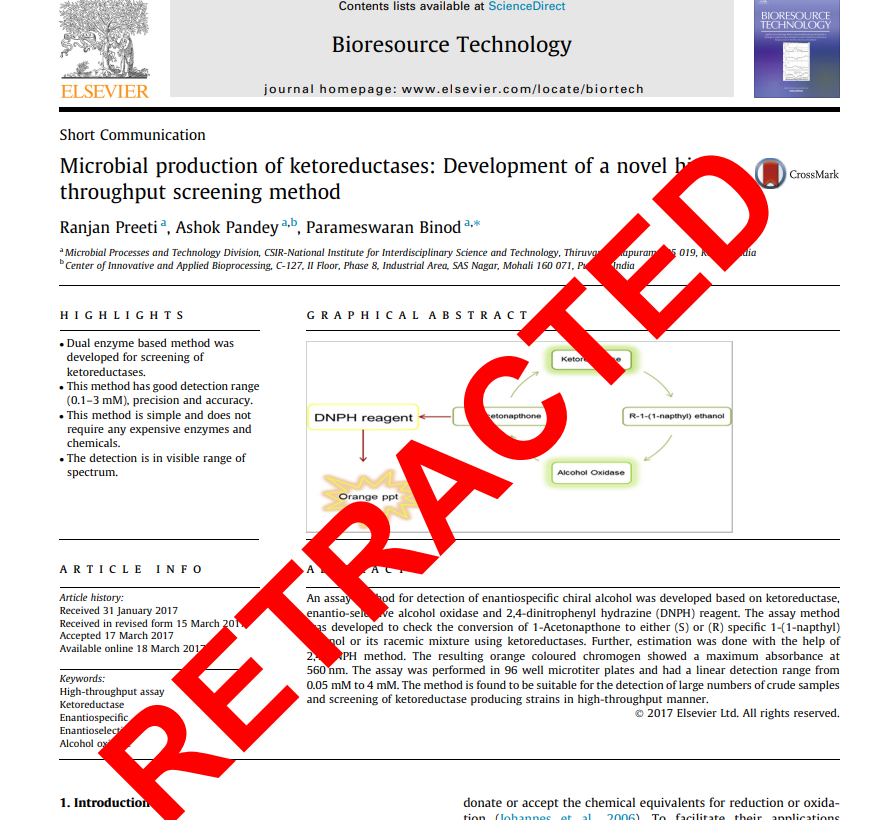
8) Microbial production of ketoreductases: Development of a novel high-throughput screening method
9) Molecular improvements in microbial α-amylases for enhanced stability and catalytic efficiency
11) Bioflocculation: An alternative strategy for harvesting of microalgae – An overview
12) Recent developments in l-glutaminase production and applications – An overview
13) Expression system for heterologous protein expression in the filamentous fungus Aspergillus unguis
14) Strategies for design of improved biocatalysts for industrial applications
17) Thermostable cellulases: Current status and perspectives
18) Microbial strategies for bio-transforming food waste into resources
19) Lignocellulosic bio-refinery approach for microbial 2,3-Butanediol production
20) Potential carbon dioxide fixation by industrially important microalgae
21) Water hyacinth a potential source for value addition: An overview
23) Crude oil biodegradation aided by biosurfactants from Pseudozyma sp. NII 08165 or its culture broth
28) Biological pretreatment of lignocellulosic biomass – An overview
29) Evaluation of hydrotropic pretreatment on lignocellulosic biomass
30) Thermostable phytase in feed and fuel industries
31) Biotechnological applications of inulin-rich feedstocks
32) Pretreatment strategies for enhanced biogas production from lignocellulosic biomass
35) Thermostable xylanases from thermophilic fungi and bacteria: Current perspective
36) Biocatalytic strategies for the production of high fructose syrup from inulin
38) A novel sono-assisted acid pretreatment of chili post harvest residue for bioethanol production
39) Lignocellulosic ethanol in India: Prospects, challenges and feedstock availability
42) An organic-solvent-tolerant esterase from thermophilic Bacillus licheniformis S-86
43) Metagenomics for taxonomy profiling: tools and approaches
Published in The Hindu on July 18, 2024