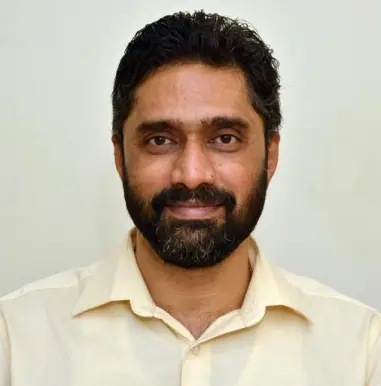
Achal Agrawal, Research-Integrity Sleuth From India, Among ‘Nature’s 10 People Who Helped Shape Science In 2025’
The recognition by Nature has come just three years after Dr. Achal Agrawal began raising awareness about and reporting on research-integrity violations by Indian researchers through the India Research Watch (IRW), a volunteer-run, non-profit organisation he founded in November 2022
Dr. Achal Agrawal, a research-integrity sleuth based in Raipur and Founder of the India Research Watch (IRW), is one of Nature’s 10 people who helped shape science in 2025. The recognition has come just three years after he began raising awareness about and reporting on research-integrity violations by Indian researchers through the India Research Watch (IRW), a volunteer-run, non-profit organisation he founded in November 2022. The India Research Watch is already popular and well known among researchers in India. That it has 79,000 followers on LinkedIn is a testimony to its popularity.
Efforts bear fruits
There is a clear reason why Dr. Agrawal was chosen by Nature as one of the 10 people who helped shape science this year. Along with a few others, his sustained efforts over the last few years led to the landmark policy change introduced by the National Institutional Ranking Framework (NIRF) in July this year — to penalise all higher educational institutions that have retractions in the last three calendar years while calculating the rankings. The penalty — negative weightage for retracted papers and their citations — was mild this year as the policy change was introduced just months before the rankings were to be announced. According to Dr. Anil Sahashrabudhe, Chairperson of the National Board of Accreditation (NBA), the agency managing the NIRF, the penalty will become “harsh next year and harsher in the future if institutions continue to have a large number of retractions every year”. He does not rule out the possibility of black listing institutions for a few years if the retractions “stayed high”.
Dr. Agrawal earned his PhD in applied mathematics in 2016 from the University of Paris-Saclay in Orsay, France. He was not employed in November 2022 when he began the India Research Watch and remained so for a year. He resigned from a Lucknow-based institution in May this year and remains focussed on his pet project of raising awareness about research misconduct and sensitising institutions and policy makers about research integrity. Besides posting on social media platforms, he has written research papers and popular articles in newspapers.
Reaching out to the Indian scientific community
At a time when senior researchers, institutions and policy makers have been indifferent to even serious research integrity issues, and PhD students and young professionals have been largely ignorant of what constitutes scientific misconduct, it is unsurprising that there was a near radio silence on social media platforms for the first seven months after he launched the IRW initiative. But things started changing slowly. “There was some motivation when people began reading and discussing what was posted. The fact that message was reaching the target audience was highly encouraging,” he says. “The Indian research community is not big. So the number of followers on LinkedIn is indeed sizable and the discussion that is taking place is encouraging. Happy that the message is reaching the community.”
If a private university based in Chennai tried to silence him earlier this year by filing a case against him, all the Board Members and the U.S.-based Retraction Watch, the NIRF’s decision to penalise higher educational institutions for retractions has proved to be a counterweight and a shot in the arm for him.
While students and scientists are aware of retractions, Dr. Agrawal says many are not aware what violations lead to retractions. “Many are unaware that boosting citations can lead to retractions. Similarly, many are not aware that gifting authorship, if proven, can lead to retractions. Since they are unaware, they continue indulging in such research misconduct,” he says.
NIRF needs to transparent
Though he is happy that NIRF has finally recognised the rising number of retractions from India and has decided to penalise institutions that indulge in scientific misconduct leading to retractions, Agrawal complains about the erratic manner in which institutions have been penalised. “The ranking of one institution that is ranked high on [University of Beirut-based] Dr. Lokman Meho’s Research Integrity Risk Index has actually increased, while the ranking of some others with high ranking on Meho’s index has reduced,” says Agrawal. Dr. Meho’s Index had taken into account the rate of retractions per 1,000 publications over the preceding two full calendar years (2022-2023), and papers published in journals that are delisted from the scholarly databases Scopus and Web of Science.
Dr. Agrawal complains that the source of retractions that NIRF uses to penalise institutions is not known. “My suggestion would be to use the retraction database compiled by the Retraction Watch,” Dr. Agrawal says. He also complains about NIRF not making public the information about which institutions were penalised. “Why should this information remain in a black box?” he asks. “Putting out the names of institutions that were penalised for retractions will help students and parents make an informed decision as NIRF’s ranking is the sole criterion used by most parents and students to decide where to study.”
“One of the biggest criticisms of the NIRF penalty is that it ignores retractions arising from honest mistakes. This is where the Retraction Watch database proves particularly useful as it cites the reasons behind each retraction,” he says. Citing the data from Postpub website developed by him, he says honest mistakes leading to retractions are significant at 20%.

India second highest in the world for retractions
Of the 5,412 retractions from India between 1996 and 2024 (with an average retraction rate of 1.8 per 1,000 publications), 49% fall under the ‘Serious’ category, followed by 33% due to research integrity issues. The number of retractions has more than doubled from 300 in 2019 to about 650 in 2020. It increased sharply from about 650 in 2020 to over 900 in 2021 and about 900 in 2022 before dropping to 400 in 2023. It must be noted that retractions take on an average two years after a paper is published. Therefore, the drop in numbers in 2023 could just be because papers have not been retracted yet as they were published only recently.
India has been ranked number two behind China for the number of retractions for four consecutive years. This makes a strong case for making the penalty for retractions really harsh.
‘Quite impressed’
Dr. S.C. Lakhotia, BHU Distinguished Professor & Former SERB Distinguished Fellow, and a Board Member of IRW is all praise for Dr. Agrawal. “He is committed and is doing what is necessary. Quite impressed with his thinking and what he is doing,” he says. “The current ranking system is destroying the academic ecosystem. The focus should be on quality and not just quantity. The India Research Watch is working in that direction. Hope he succeeds. We Board Members are there to support him.”