
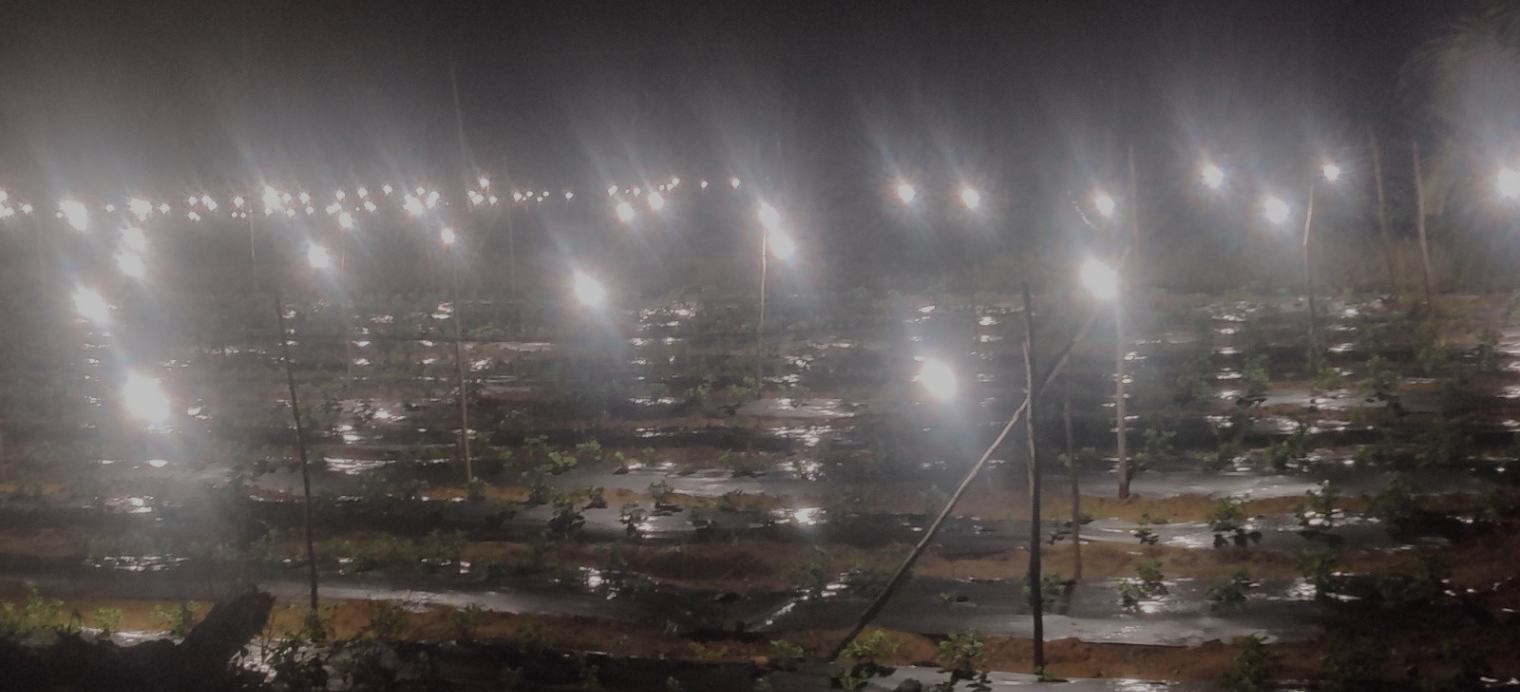
Night-Break Lights For Chrysanthemum: How Farmers ‘Hold’ The Night To Time A Perfect Flush
Chrysanthemum will flower only when the nights are long enough. Lighting the fields using low-intensity bulbs during the night resets the plant’s clock and stops the flower signal, so the crop keeps building height and branches. When it is ready for the market window, the lights are switched off, giving true long nights. The buds initiate together and a uniform flush arrives in about six to 11 weeks
Driving from Chennai to Lepakshi, which is in the Sri Sathya Sai district of Andhra Pradesh, and somewhere between Avani and Lepakshi, easing through the Chintamani side roads, the hills suddenly turned into constellations. Whole fields glittered at ground level. From a distance the lights sat low, like diyas laid out in long strings. Only when we pulled up beside a plot did it click. Those were not decorations or heaters. They were night-break lights for chrysanthemums — a trick as elegant as it is simple: a whisper of light in the middle of the night that tells a short-day plant, “Not yet. Keep growing.”
As a plant physiologist, I could not let that pass as just a nice photograph. I did my homework, spoke to a couple of friends from the Kolar-Chintamani belt, and pieced together what is essentially a science-to-practice success story. It is not ancient lore. It is careful physiology, tested in labs and greenhouses, adopted by growers, and now scaled across open fields to meet the festival and wedding market windows.
What the little bulbs do
Chrysanthemum is a classic obligate short-day plant. In plain English, it needs long, unbroken nights to flower. The plant’s internal light sensor — phytochrome — shifts between two forms. Through the night, it drifts to phytochrome red (Pr) form. In case of a brief pulse of red-rich light right in the middle of that dark window, the phytochrome flips back to phytochrome far-red (Pfr), which the plant interprets as ‘daytime happened’. The result? The uninterrupted ‘night’ has been broken. The floral switch does not flip. The crop stays vegetative.
This is more than a light trick; it is a gene-level decision made in the leaves. Under true short days, FT-like florigen genes (CsFTL3 or CmFTL3) rise, and the flower order is sent to the shoot. Under long days — or when growers interrupt the night — the balance shifts to anti-florigen, FT stays low, and the plant keeps building height and branches. When growers finally stop the night-break and guarantee genuinely long, dark nights, buds initiate together and the crop moves toward a uniform bloom in about six to 11 weeks, depending on the variety’s ‘response group’.
Why growers love the practice
Think of it as ‘build first, bloom later’. By holding the plant vegetative a bit longer, the nodes and side branches are stacked up. That translates to saleable stem length and more inflorescences after induction — within the genetic ceiling limit of the cultivar, of course. The key is timing: too short a vegetative phase, the stems are stunted stems and there are fewer blooms; too long a night-break and the flowering is delayed past the market, sometimes with smaller heads.
Temperature matters too. The first fortnight after the lights are switched off is a sensitive period. Warm nights can cause ‘heat delay’, leading to uneven budding and quality dips. That is the reason why in South Indian winters, growers guard those dark hours carefully — no stray yard lights, no tractor headlamps lingering, sometimes even simple shading fixes along the road-facing side.
How little light is ‘enough’
These are not ‘grow lights’. It is not photosynthesising at night but sending a time signal. Field-proven recipes are remarkably modest: around 10-15 foot-candles at the canopy (call it about 100-150 lux or about 2-3 μmol m⁻² s⁻¹) is typically sufficient for an effective night break. Many farmers run a continuous four-hour window — say 10 pm to 2 am — while others use cyclic lighting (for example, repeating cycles of six to 10 minutes on, 20-24 minutes off) to save power. Red-weighted light is the most potent for blocking flower induction; a far-red pulse immediately after can undo that effect, which is the classic photoreversibility one reads in textbooks.
Spacing and height are practical details, not dogma. Older recommendations for incandescent strings — one bulb every two-three metres in a simple grid —translate reasonably well to LEDs when one maintains the same measured density at plant height. Outdoors, wind, and uneven ground make the pattern imperfect, so the smarter growers walk the beds with a cheap light meter to confirm they are actually giving about 10-15 foot-candles across the canopy, not just at the pole.
Precision scheduling, not show
When one sees those fields of low lights in Kolar-Chintamani, it is not about warming the air or scaring pests. It is precision scheduling. By holding nights ‘short’ for weeks, farmers keep the crop vegetative and build architecture. When it is time to catch a festival window — Dasara, Deepavali, Sankranthi — or wedding demand, they stop the night-break. With nights now truly long and dark, buds initiate together. About six to 11 weeks later, a uniform flush results that can be harvested, graded, and moved to market at the best possible price.
A clean ‘field recipe’
If one is setting this up for the first time, keep it simple. Run night-break lights from 10 pm to 2 am. Aim for about 10-15 foot-candles at plant height across the bed; don’t guess — measure. Keep this going until plants hit your chosen height and branch count. Then, on your ‘week 0’, switch off lighting completely and guard the dark for at least two weeks — no spill light, no late tractor passes. From there, the cultivar’s response group takes over. In a six-week responder one will see marketing bloom around week six; an eight-week one will need two more weeks, and so on.
Planning backwards for Sankranthi 2026
Let’s say the sale window is Makar Sankranthi 2026 — typically January 14 in the South. To hit that market with open flowers, stop the night-break lights about six to 11 weeks earlier, depending on the variety’s response group. Here’s a simple count-back plan one can copy into a field diary:
- If the variety is a six-week responder: Stop night-break on December 3, 2025. Guard nights from that day forward. Expect a marketing flush around early-mid January 2026
- If it is a seven-week responder: Stop on November 26, 2025
- If it is an eight-week responder: Stop on November 19, 2025
- If it is a nine-week responder: Stop on November 12, 2025
- If it is a 10-week responder: Stop on November 5, 2025
- If it is an 11-week responder: Stop on October 29, 2025
These stop-dates give one a clean glide-path to a January 14, 2026 market. If buyers prefer slightly tighter buds (to travel and open at destination), pull the stop-date forward by three-five days. If you expect unusually warm nights in the two weeks after you stop lighting, consider adding low-tech light-spill control (baffles on road-facing edges) and ensure irrigation keeps root zones even — both help reduce ‘heat delay’ risks.
Two practical tips from growers
- Consistency beats intensity: A steady four-hour night-break at about 10-15 foot-candles every single night is better than powerful light some nights and nothing on others. The plant is measuring unbroken dark; gaps undo careful scheduling.
- Protect the first 14 nights after switch-off: Those two weeks set the uniformity. If there is one time to be fussy about stray light, this is it.
Cultivar behaviour and quality
Chrysanthemums differ in sensitivity. Some cultivars respond strongly even at the lower edge of night-break intensity, while others are a bit stubborn and need closer spacing or slightly longer interrupt windows. It is worth doing a tiny ‘calibration bed’ early in the season — run a planned setup on one half and a slightly richer setup (say, over two-three foot-candles or a modestly longer cycle) on the other. One can quickly learn whether the chosen cultivar needs the extra nudge. Important to remember that prolonged night-breaks can stretch plants more than one wants. It is necessary to keep an eye on nodal length and stay prepared to tweak fertilisation and plant growth regulator strategy if there is excessive internode elongation.
The bigger picture
What I love about those glowing fields is how quietly they connect fundamental science to rural economics. A pigment that flips between two forms with red and far-red light. A leaf that decides ‘flower now’ or ‘not yet’ and sends a message to the shoot. A grower who turns a switch for four hours a night to hold the crop until the festival trucks roll. That is a hundred years of plant biology, moving from bench to greenhouse to open fields in Karnataka — ending not in a lab figure, but in a farmer’s better price on a winter morning.

