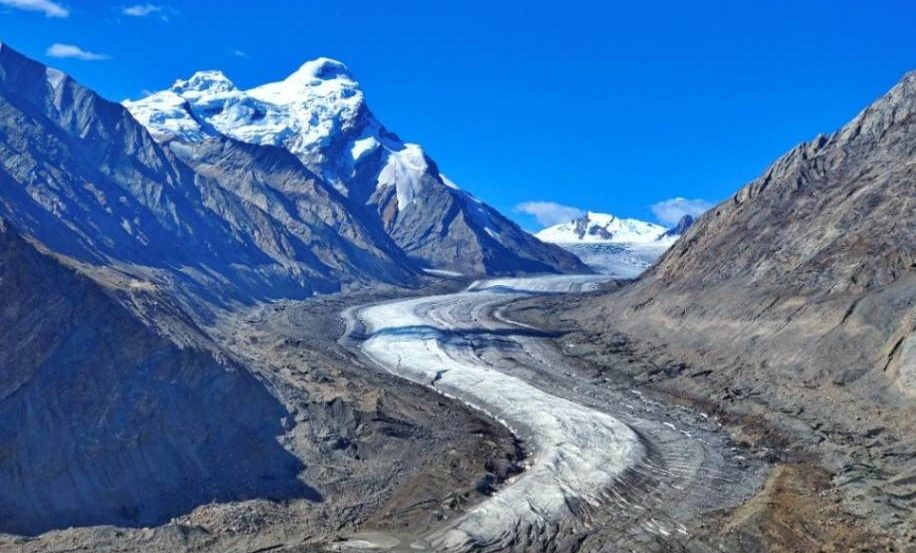
Durung Drung and Pensilungpa: The Changing Face of Ladakh’s Glaciers
Though located in the same climatic zone, aspect, and slope, Durung Drung glacier lost over eight sq. km area and retreated more than 800 metres, while the Pensilungpa glacier lost just over two sq. km and retreated only about 200 metres. Besides the warming climate, other factors too have a role to play
It is widely recognized that glaciers are highly sensitive to climatic change, and a lot of research has been focused on the response to increased global temperature (since 1950 onwards) and on evaluating future changes under the present climate change scenarios. Changes in glacier mass balance and its components are the most reliable indicators of climatic change. These are determined by winter accumulation (snowfall) and summer ablation (melting), which are, in turn, driven by anomalies in global and regional atmospheric circulation, as well as changes in local weather patterns and specific glacier characteristics (e.g., altitude, aspect, and supraglacial debris).
The Himalaya contains thousands of glaciers of widely varying properties, which are spread over nearly 37,000 sq. km with an east-west range of over 2,000 km. One of the significant characteristics of the Himalayan glaciers is that the glaciers are mainly debris-covered (70-80%) and have been receding since the end of the Little Ice Age. The supraglacial debris on the surface of glaciers is commonly found to have significant control over the rate of ice ablation and recession. Particularly, the thickness of supraglacial debris significantly alters the glacier response to climate forcing. Using remote sensing and field-based data in different parts of the Himalaya, several studies, such as mapping debris cover and its correlation with glacier melting and recession, have been carried out.
Variable glacier retreat
As a consequence of the complex climate system, glacial geometry, glacier surface properties, and geology, the recession rates of the glaciers are variable. The studies suggest that most of the Himalayan glaciers are retreating between five and 20 meters per year with the negative mass balance (when a glacier loses more ice or snow than it accumulates) varying between 0.2 to 1.2 meters water equivalent per year (m w.e.a -1) and equilibrium-line altitude (ELA) — the area or zone on a glacier where accumulation is balanced by ablation over an one-year period — fluctuating between 4,900 and 5,300 metres above mean sea level. Glaciers are key markers of understanding climate change, so monitoring of glaciers in terms of estimating the overall changes of mass, volume, area, and length over space and time is essential.
Despite the importance of the Himalayan glaciation, knowledge of the glacial dynamics and forcing factors is scanty. Recent studies of Himalayan glaciers indicate wide variability in terminus (leading edge of a glacier) retreat rate and mass balance in different sectors of the mountain range, primarily linked to the topography and climate of the region. However, variable retreat rates of glacier termini and inadequate supporting field data (e.g., mass balance, ice thickness, velocity) of the Himalayan glaciers make it challenging to develop a coherent picture of climate change impact.
High above Ladakh’s rugged Zanskar Valley, glaciers sprawl like frozen rivers, feeding the Indus basin and sustaining millions downstream. Among them, Durung Drung and Pensilungpa stand as icy sentinels. Recent scientific studies reveal that these glaciers are far from still, they are thinning, retreating, and even speeding up. Their story is both a scientific revelation and a warning about our changing climate.
The Durung Drung Glacier, stretching 23 km from the Pensi-La pass, is one of the largest in the region. Using decades of Landsat satellite images and an advanced software tool called COSI-Corr, we tracked how fast its ice is moving. At the turn of the millennium, Durung Drung crept forward at about 71 metres per year. Two decades later, it had almost doubled its pace to 140 metres per year (The Egyptian Journal of Remote Sensing and Space Sciences).
This acceleration is linked to rising temperatures: warmer summers generate more meltwater, lubricating the glacier’s base and allowing it to slide faster. But faster isn’t better. As more ice is pushed into the lower melting zone, the glacier loses mass more rapidly. This means short-term surges in river flow, but long-term decline in stored ice, threatening water security for Ladakh and beyond.
A natural experiment
While velocity tells one part of the story, another study (Sustainability) of ours looked back over forty-four years to assess changes in Durung Drung and Pensilungpa glaciers. Though located in the same climatic zone, aspect, and slope, their responses to the same climate have diverged. Durung Drung, the larger “clean” glacier, lost over eight sq. km area and retreated more than 800 metres. Pensilungpa, smaller but covered in rock debris, lost just over two sq. km and retreated only about 200 metres. Both glaciers saw their snowlines climb higher by 104 metres for Durung Drung and 88 metres for Pensilungpa: a clear sign of reduced snow accumulation. At the same time, debris cover expanded steadily on both glaciers, changing the way they melt.
The contrast highlights how topography and surface conditions shape a glacier’s destiny. Durung Drung’s thin debris cover (only 5.5% area) and broad slopes (about 2 km) expose it to greater melting, while Pensilungpa’s thick debris cover acts like a blanket, sometimes insulating the ice beneath. A February 2023 study by another team found that the Pensilungpa glacier lost its length at a “two times slower rate” than the Durung-Drung glacier even as both glaciers lost about similar percentage of the length — 3% of the total length. This natural experiment shows that not all glaciers respond equally to the same warming climate, complicating predictions for the region as a whole. Other factors such as snout geometry, glacier size, elevation range, slope, aspect, debris cover, and presence of supra and proglacial lakes too have a role to play.
These findings matter far beyond the mountain valleys where the glaciers sit. They are not just frozen landscapes; they are water towers of the Himalaya. The Doda and Suru rivers, fed by these glaciers, irrigate fields, power turbines, and sustain communities downstream. As glaciers retreat and accelerate, their contribution to rivers changes, first causing unpredictable floods, then leading to scarcity as reserves dwindle. Faster flow also raises the risk of glacial lake outburst floods, sudden surges that can devastate mountain villages. Long-term shrinkage, meanwhile, erodes Ladakh’s already fragile water security.
Monitoring glaciers using satellite data
Together, our two studies highlight the power of satellites in monitoring remote glaciers where fieldwork is difficult, but they also stress the importance of combining space-based data with ground measurements. Only such integration can sharpen forecasts of water availability and hazards in a region where millions depend on glacial melt. The message is clear: Himalayan glaciers are changing faster than ever. Each metre of retreat, each rise in snowline, each acceleration of ice flow is a signal of a warming world. Protecting communities that depend on these rivers will require vigilance, adaptation, and sustained scientific observation. The Himalayas, often called the Earth’s “Third Pole,” are on the move, and what happens to glaciers in Ladakh today will echo in the lives of millions tomorrow.
The stories of Durung Drung, and Pensilungpa glaciers illustrate how climate change is reshaping the Himalayas in complex and uneven ways. Some glaciers are accelerating, others are shrinking at different rates, and all are losing their long-held balance. These changes are not distant or abstract, they directly affect water supplies, ecosystems, and livelihoods across South Asia. Continued observation, both from satellites and on the ground, will be vital for anticipating risks and planning adaptation. Above all, these glaciers remind us that the impacts of a warming climate are already unfolding, and the choices we make today will determine whether the “water towers of Asia” can continue to sustain future generations.