
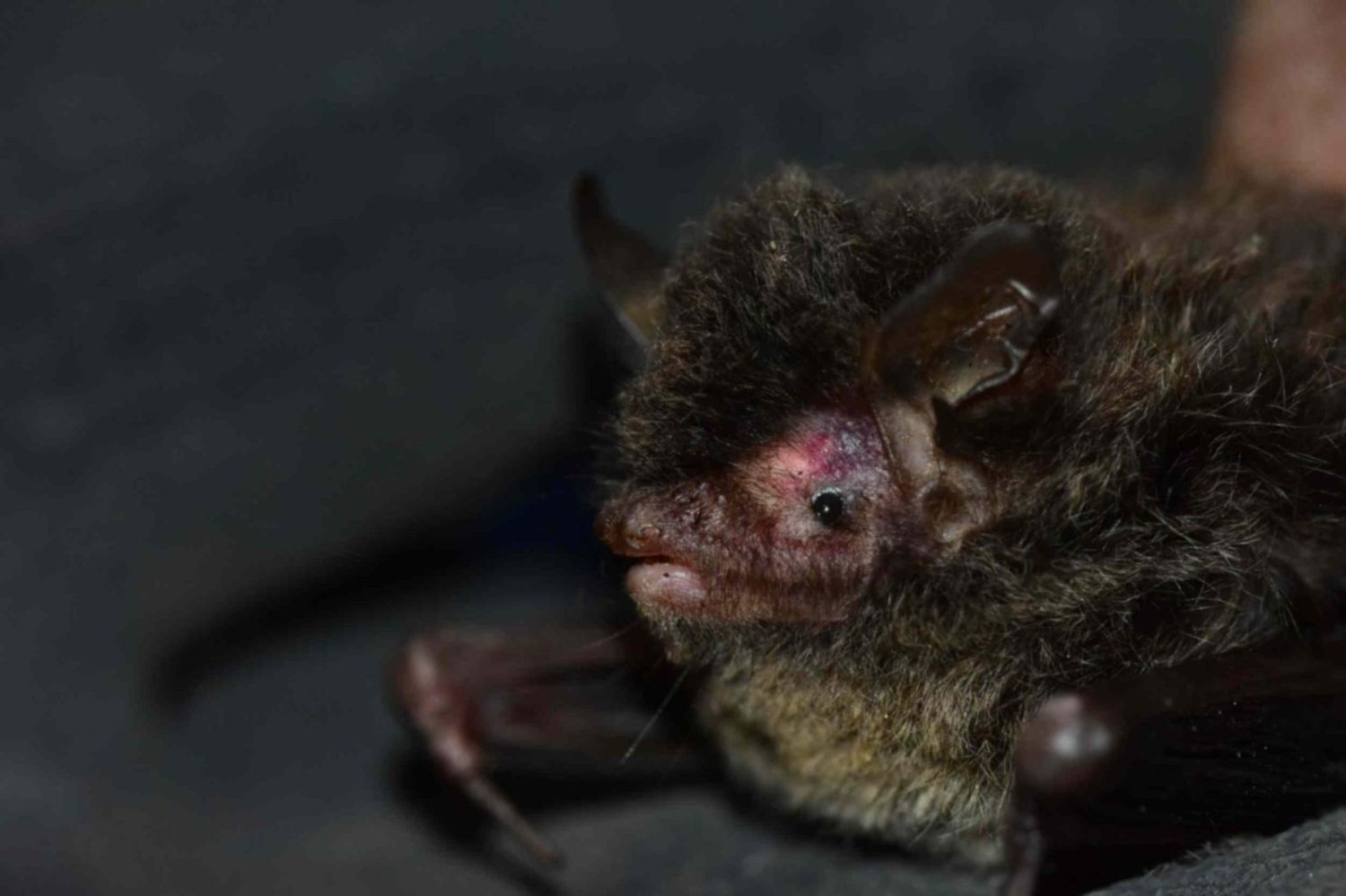
Discovering India’s newest flying mammal — the Himalayan Long-tailed Myotis bat
The newly discovered Himalayan Long-tailed Myotis bat from Uttarakhand is a small, insectivorous bat weighing 6 grams and less than 5 cm long from snout to vent. The tail is nearly as long as the body. Like all insectivorous bats in India, this species is a fluffball with dark brown hair, and its face is bare and salmon pink
Ansuya is a dreamy little village of about ten houses. On a normal day, devotees would visit the famous Ansuya Mata Mandir and hikers would take a pitstop on their way to the Rudranath temple. But during the deadly second wave of COVID-19, four of us — my field assistants Baseer and Saddam, an intern, Jaskirat, and I — were left to the company of our cheerful lodge caretaker Guddu uncle. In Nagpur, my family is celebrating my father’s birthday. Thanks to technology, standing 1,500 km away from home at the edge of a cliff where my cell phone picks 4G signal, I order a cake for my father. On the same day in 2017 when I was also doing fieldwork in this area, I had rediscovered the rare Sombre Bat (Cnephaeus tatei) after 40 years (as I recall in my cover story published in February 2025). Will I be as lucky again?
Our nets are placed nearby at the edge of an oak forest lined by thickets with a small puddle of water at its centre. Some mornings ago, a pair of restless Aberrant Bush Warblers was flitting in the thickets. Being a birder alongside a bat researcher, I often use my knowledge of birds to decide mistnetting locations for bats. The presence of skulking understorey birds is my clue for a less disturbed habitat, so this netting site holds promise. After modest captures of two Nepalese Whiskered Bats (Myotis muricola) in the first hour after dusk, excitement peaks when Baseer joyfully brings two bags dangling from his hands. In one bag is the source of his excitement: a Collared Scops Owl! After a quick photoshoot of the owl (and of Baseer with the owl), we move on to the next bag. Baseer mentions that it’s a bat like the Nepalese Whiskered Bat but not quite the same. As soon as I pull the bat out of the bag, I am in for a huge surprise. We finally got the bat I was chasing for the last four years. A new species of bat from the Himalayas is finally in sight!
The rocky road: 2016-2021
I first caught this enigmatic species in 2016 in Devalsari (a village with beautiful cedar forests, 40 km from Mussoorie) and again in 2017 in Mandal in Kedarnath Wildlife Division. At that point all that I could tell is that it’s a species of the genus Myotis and its characters do not match any species represented in our outdated field guides and identification keys. After seeking the inputs of three of my expert collaborators — Dr Manuel Ruedi from the Department of Mammalogy and Ornithology, Natural History Museum of Geneva, Geneva, Switzerland, Dr Uttam Saikia from the Zoological Survey of India, North Eastern Regional Centre, Shillong, Meghalaya, and Dr Gabor Csorba from the Department of Zoology, Hungarian Natural History Museum, Baross, Budapest, Hungary — we identified it as a Fraternal Myotis (Myotis frater), a species of forested areas of southern and eastern China and Taiwan. However, our genetic data suggested that this Himalayan bat was 12% divergent from Fraternal Myotis suggesting that it was highly unlikely that the two are the same species. Unfortunately, I lacked permits to preserve a specimen and that precluded anatomical examination.
In 2018, as I started fieldwork for my PhD on the bats of Kedarnath Wildlife Sanctuary, I was granted a specimen collection permit. In 2017, my team and I had caught four individuals of the ‘Myotis-frater-would-be-new-species’ in different locations in Mandal valley. My PhD fieldwork was going to last three summers so getting those missed specimens sure wasn’t going to be difficult. Or so I thought. Between 2018 and 2021, we caught everything but the potentially new species. In the final days of fieldwork in May 2021 at the Kedarnath Wildlife Sanctuary, Uttarakhand, winds of luck finally swung in our favour.
Confirming a new bat species
If capturing the specimen wasn’t easy, the job that followed was even more difficult. Thankfully I was blessed to have an incredible team of collaborators – Uttam, Manuel and Gabor. Uttam meticulously identified the key morphological and anatomical differences in our specimen. Manuel and Gabor went back to their collections in the museums of Geneva and Budapest respectively and leveraged their contacts in Asian museums. Gabor looked at his collections and chanced upon a specimen with uncanny similarities to our specimen that he had collected in Khyber Pakhtunkhwa, Pakistan in 1998. It was left unidentified then.
After scrupulously comparing morphological, anatomical, and genetic data of our specimen from Ansuya and Pakistan to closely-related species, we were finally ready to welcome a new bat species from India and Pakistan to the world: Myotis himalaicus, the Himalayan Long-tailed Myotis. Though the bat specimen was first collected in Pakistan way back in 1998, the discovery in 2021 still holds because the type specimen (the specimen from which the species is described) is the one collected in Ansuya, Uttarakhand. The Pakistan specimen instead becomes what is called a “paratype” (an additional specimen of the same species used to support the identification). Our findings were published in June 2025 in the journal Zootaxa.
The Himalayan Long-tailed Myotis is a small, insectivorous bat weighing 6 grams (the weight of a five-rupee coin) and less than 5 cm long from snout to vent. The tail is nearly as long as the body. Like all insectivorous bats of India, this species is a fluffball. It is densely covered with dark brown hair. Its face is bare and salmon pink. Also rather distinctive are its long ears that are notched towards the base.
So far, the Himalayan Long-tailed Myotis is only known from three locations in the world: Kaghan Valley in Khyber Pakhtunkhwa (Pakistan), and Devalsari and Kedarnath Wildlife Sanctuary in Uttarakhand. It appears to be a species of elevations between 1,600 to 2,300 metres where it has been caught in oak and old-growth pine forests. In Kedarnath where I have studied bats for four summers, it is clearly not a common species. Beyond this, we know nothing about the species’ diet, its breeding behaviour, where it hibernates etc.
The big picture
The Himalayan Long-tailed Myotis joins a growing series of bat discoveries from India. In the past decade, five species new to science were discovered by passionate bat researchers: Rainforest Tube-nosed Bat (Murina pluvialis), Jaintia Tube-nosed Bat (Murina jaintiana), Meghalaya Thick-thumbed Bat (Glischropus meghalayanus), Phillip’s Long-fingered Bat (Miniopterus phillipsi), and Srini’s Long-fingered Bat (Miniopterus srinii).
In the June 2025 Zootaxa paper we also described another new species, the Babu’s Pipistrelle (Pipistrellus babu) which has been split from the Javan Pipistrelle (Pipistrellus javanicus). This species is one of the commonest bats in the Western Himalayas — a new species hidden in plain sight. The erstwhile Javan Pipistrelle was thought to occur across the Himalayas and much of Southeast Asia. Based on our data, the newly described Babu’s Pipistrelle is a Himalayan endemic occurring (tentatively) from Murree, Punjab province, Pakistan to Nepal making its distribution much narrower than previously believed.
Last year, I published a paper in the journal Biodiversity and Conservation from my PhD thesis describing how bats in mountains are significantly more data deficient than those found in lowlands. Therefore, it does not surprise me when a new species is described from a mountain range. In fact, a few days back, some of my friends described a new species of bat from the mountains of Equatorial Guinea. Our discoveries are part of this trend. A new species’ discovery is undoubtedly a matter of cheer, but to paraphrase an oft-cited quote, with great discovery must come great responsibility. A new species must not remain a number such as the “1469th species of bat in the world” or the “434th mammal of India”. What this means is now there is one more bat in a habitat threatened by highway projects and the silent impacts of climate change that needs monitoring and protection.

