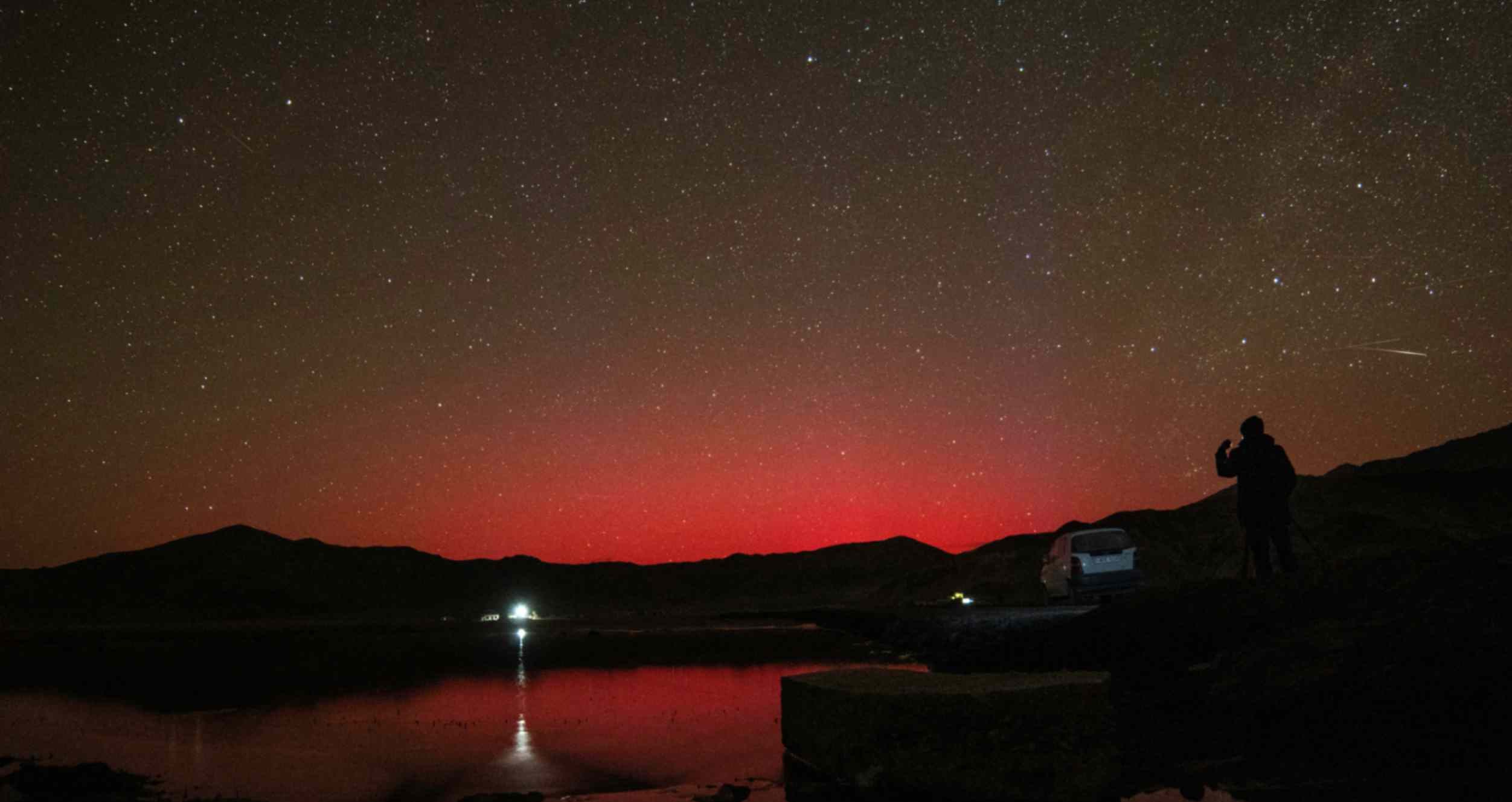
Auroras over the Himalayas: The May 2024 solar storm is a space weather wake-up call
Beyond the beautiful auroras seen even in Ladakh, the most intense geomagnetic storm of May 10, 2024, which was driven by a rare sequence of six successive Earth-directed coronal mass ejections (CMEs), reached its peak roughly eight-nine hours after onset, and took around four-five days to fully recover. Its impacts were felt both in space and on the ground
The study of celestial bodies and related phenomena in astrophysics can appear both serene and violent. Solar astrophysics, which focuses on our nearest star, captures this duality most vividly — ranging from the beauty of auroras to the violent eruptions in the solar atmosphere. While the Sun sustains life on Earth, it also threatens modern technological systems in space and on the ground through large-scale eruptions of magnetised plasma. These solar transients, such as coronal mass ejections (CMEs), when directed toward Earth, can result in a chain of disturbances in the magnetosphere and ionosphere. Such disturbances have the potential to damage satellites, power grids, GPS, radio communication, and aviation. The collective impacts of these solar outbursts are known as space weather events. Although such events occur regularly on smaller scales, some are exceptionally larger and stronger for shaping scientific understanding, testing technological resilience, and reminding humanity of its vulnerability within the cosmic environment.
Most intense geomagnetic perturbations in 20 years
In mid-May 2024, the Sun displayed its power through a series of powerful coronal mass ejections (CMEs), which, upon their arrival on Earth, produced the most intense geomagnetic storm in over two decades. The strength of the storm — marked by severe perturbations in Earth’s magnetic field — was one of the highest recorded in the space age and the highest in the last twenty years. The Dst (Disturbance storm time) index, which scientists use to measure the intensity of perturbation in the geomagnetic field in units of nanotesla (nT), plunged to –406 nT while Earth’s magnetosphere was compressed far beyond its normal boundaries. This index with a negative sign shows how much Earth’s magnetic field is weakened during a storm: the more negative the number, the stronger the storm. For context, Earth’s magnetic field at the surface near the equator normally measures about 25,000 nT. These CME-driven disturbances created impacts that rippled from the magnetosphere to the upper atmosphere and then down to the surface. This storm is dubbed the “Gannon storm” in memory of space weather scientist Jennifer Gannon, who passed away a few days before the storm struck.
The storm is now understood to have been driven by a rare sequence of six successive Earth-directed CMEs, launched between May 8 and May 9, 2024 from a large sunspot group, known to scientists as an active region (AR). This region was catalogued by the U.S. National Oceanic and Atmospheric Administration (NOAA) as AR 13664 — each new AR simply receives a running number as it appears on the Sun’s surface. As these solar CMEs travelled toward Earth one after another, they interacted along the way and formed into a complex structure which had unusually enhanced geoeffective properties, leading to the onset of the storm on May 10. The impact squeezed Earth’s magnetic field so strongly that charged particles from the CMEs and from within the magnetosphere itself penetrated deeper into our atmosphere than usual, causing both beautiful and adverse phenomena in near-Earth space.

Unusual lower latitude occurence of auroras
On the night of May 10-11, 2024, all-sky cameras at the Indian Institute of Astrophysics’ (IIA) Hanle, Ladakh, observatory at 33 degrees geographic latitude, could record red auroras dancing in the Himalayan skies. The observation of such rare low-latitude aurora in the Ladakh region — thousands of kilometres from the usual auroral oval — was very unusual, as such auroras are confined to polar latitudes. The aurora on Earth was associated with one of the most intense geomagnetic storms in over two decades.
Worldwide, auroras were also reported as far south as Texas and Greece. NASA’s Aurorasaurus project received more than 6,000 eyewitness accounts from 55 countries, including all seven continents. The aurora-associated geomagnetic storms’ impacts on satellite malfunctions, GPS disruptions, and power grid instabilities were a reminder that space weather is no longer an abstract scientific curiosity but also a clear warning for a society where space infrastructure and a digital economy are woven into daily life.
Technological strain across the globe
When the CMEs struck the Earth, the consequences were not confined to the beautiful aurora in the skies. The associated geomagnetic storm put unprecedented strain on modern technological systems across the globe. The storm reached its peak roughly eight-nine hours after onset, and took around four-five days to fully recover. Its impacts were felt both in space and on the ground.
- Satellites in peril: Low-Earth orbit satellites, particularly SpaceX’s Starlink constellation, faced increased atmospheric drag. Both reentry rates and prediction errors surged during geomagnetic storms, complicating collision-avoidance planning.
- GPS disruptions: In the United States, high-precision GPS modes saw position errors of up to 70 metres, disrupting agriculture machinery that depends on sub-meter accuracy.
- Atmospheric heating: NASA’s GOLD mission recorded unprecedented temperature gradients between the equator and the poles and depletion in oxygen-to-nitrogen (O/N₂) ratio at higher latitudes, indicating substantial heating. These atmospheric effects persisted for one-two days after the storm’s onset.
- Aviation rerouting: High-frequency (HF) radio blackouts over the Atlantic forced the transoceanic flight rerouting, as large portions of the 2–12 MHz spectrum were unusable for several hours after the storm onset.
- Power grid vulnerability: In New Zealand, geomagnetically induced currents (GICs) peaked above 100 A levels unseen in two decades. Emergency protocols were activated, and some power lines were taken out as part of a mitigation plan soon after the storm’s onset to prevent potential blackouts.
Tracing solar transients’ full journey
Our team from the Indian Institute of Astrophysics (IIA), which also included doctoral scholars Mr. Soumyaranjan Khuntia and Ms. Anjali Agarwal, investigated the solar transients responsible for the great geomagnetic storm of May 2024. Using observations from NASA and ESA spacecraft along with the Flux Rope Internal State (FRIS) model, we tracked the kinematic and thermodynamic evolution of successive CMEs from the Sun to Earth.
In connection with this storm, we derived the 3D kinematics of the CMEs and confirmed the interaction of several pairs of CMEs at different distances from the Sun. These interactions led to the formation of complex ejecta later identified at 1 AU. Tracking CME evolution is crucial for understanding how interactions alter CME dynamics and for improving the accuracy of their arrival-time predictions at Earth. In situ observations of plasma density, temperature, magnetic field, and polytropic index of magnetic ejecta (MEs) within the complex structure, as well as substructures such as interaction regions between two MEs and unusual double flux rope-like features within a single ME, provided further evidence of CME-CME interaction. Normally, a single ME contains just one bundle of twisted magnetic field lines — called flux ropes — while the presence of two such separate bundles with opposite orientations packed in the same ejecta is identified as double flux rope-like structures. To examine the thermal states of these CMEs, we applied the FRIS model, previously developed and tested. The model revealed diverse thermal evolution near the Sun: all six successive CMEs (CME1 to CME6) transitioned to an isothermal state at six-nine solar radii, except CME4, which remained in an adiabatic state due to its lower expansion rate. Interestingly, electrons and ions in the complex ejecta behaved differently — electrons predominantly released heat, while ions exhibited a bimodal distribution of thermal states, indicating distinct energy dissipation pathways.
Our study also confirmed that the storm’s strongly southward and compressed magnetic field orientation maximized energy transfer into Earth’s magnetosphere, producing one of the most intense geomagnetic storms and associated space weather events. Published in the journal Astronomy & Astrophysics, our represents the first continuous Sun-to-Earth thermodynamic tracking of multiple interacting CMEs. These findings mark a milestone for India in the global effort to understand CMEs and their heliospheric evolution, necessary for accurately predicting space weather.
Prelude to the May 2024 aurora
The May 2024 great storm did not arrive without precedent. A year earlier, in April 2023, a severe geomagnetic storm driven by CMEs, launched from the Sun on 21 April, also lit up the skies over Hanle, Ladakh, India, and generated significant scientific and public interest. The severe geomagnetic storm of April 2023 also led to several ionospheric changes that had adverse impacts on satellite navigation services. This was the first such auroral sighting from the Indian region in the space era.
Our team from IIA, Bengaluru, in collaboration with researchers from other Indian institutes, investigated this rare low-latitude aurora. Our study indicated that the red aurora observed from Hanle, India, resulted from emissions at higher altitudes around 600-650 km, caused by low-energy electron precipitation in the auroral oval, which extended down to about 50 degrees north geographic latitude. The analysis further suggested that the low-energy electrons likely originated from the plasma sheet (region of hot and denser plasma near the equatorial plane in the magnetotail between the north and south tail lobes) and were precipitated as a result of enhanced wave — particle interactions triggered by strong magnetospheric compression. The study clarified that the aurora was not directly overhead at Hanle but appeared near the northern horizon. This indicates that the equatorward boundary of the auroral oval had not actually reached Hanle’s latitude. The study provides important insight into the occurrence of low-latitude auroras across the globe.
A call to action for India’s space weather preparedness
The aurora and great geomagnetic storm of May 2024 should not be considered merely as a rare event but as a clear warning. Extreme space weather is no longer just a scientific curiosity; it is capable of dragging satellites out of orbit, disrupting GPS signals, and overloading power grids. Our country needs to advance its space-weather research capabilities, enhance the resilience of its infrastructure, and raise greater awareness among the policy makers and the public. Building a robust space-weather forecasting network will require expanded solar monitoring, continuous tracking of solar transients through the interplanetary medium, and the integration of analytical, empirical, MHD, and AI-based models, along with dedicated solar missions for heliospheric observations. Strengthening India’s partnerships with international agencies can enhance our early-warning capabilities and better prepare us for future space weather events.
Featured image credit: Wangchuk Namgyal