
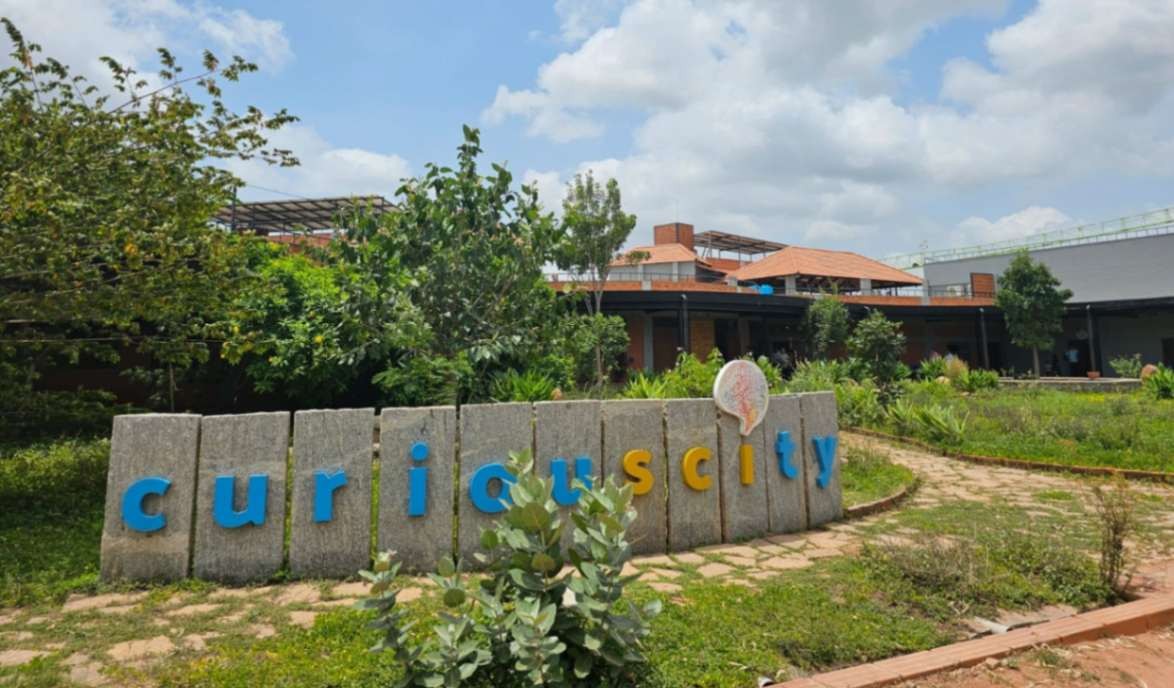
Curiouscity Science Discovery Centre: Where science becomes fun
With over one lakh visitors to date, the Bengaluru-based Curiouscity science centre has exhibits and experiments for children aged 8-15 years that have been designed by experts from IITs, IISc and Cornell, and facilitated by trained guides. It takes at least three hours to fully cover the centre and interact with the models
Tucked away from the buzz of Bengaluru traffic, in a tranquil patch off Sarjapura Main Road, sits an infinity-shaped building, the Curiouscity Science Discovery Centre, where science meets play to spark wonder and ignite young minds.
Dr. Shonali Chinniah started Curiouscity with her husband, Anil Chinniah, to make science accessible and encourage kids to explore the concepts of science more deeply by asking questions. With a PhD in Marine Ecology from Cornell University and experience working in the U.S. and India, Dr. Shonali saw how Indian education often focused on rote learning.
“When I started teaching 11th-grade biology at a private school in Bengaluru, I began to question how the Indian exam system worked. We seemed to train our children to answer questions instead of asking questions. I began experimenting with teaching: Instead of giving them an exam, I asked them to write question papers, and graded them on that. I took them to the Indian Institute of Science campus and had them visit several labs and understand the research happening there and design their own experiments,” explains Dr. Shonali in an email.
Teaming up with like-minded people
Dr. Shonali team up with a handful of like-minded people including Umesh Malhotra, CEO of Hippocampus Learning Centres, which creates reading facilities for underprivileged children in rural schools; Dr. Jandeep Banga, Managing Director of Banga Hospitals, who is actively involved in creating science modules and conducting science workshops for children; Dr. Sukanya Sinha, Visiting Professor, Indian Statistical Institute (ISI), Bangalore and; Utpal Chattopadhaya, Director of Anweshaa, an organisation that focuses on Science and Technology education
They registered a company, “Curiouscity”, and started doing more structured workshops over weekends for school children. “Over the years, as our science workshops were developing, in my mind’s eye, I had the idea of creating a unique space where we could get children to tinker with science, and I started to imagine creating a science space for kids in Bangalore. We did approach several funders for help to build such a space in Bangalore…but nothing came of it. It is only later, when the other partners pulled out of Curiouscity, that my husband and I took over and decided to build the Curiouscity Discovery Centre on a piece of land we had invested in several years ago. Curiouscity Discovery Centre did not happen suddenly, but many things came together…and the ideas slowly came into fruition,” explains Dr. Shonali.
Understanding the world around us
In 2018, they began the process of building this interactive space for children with bootstrapping. The centre was officially opened to the public in July 2022.
With over one lakh visitors to date, Curiouscity science centre has exhibits and experiments that are designed by experts from IITs, IISc and Cornell, and facilitated by trained guides. Curiouscity welcomes, on average, two schools every week, each comprising 100 to 120 students. The centre’s eight full-time educators divide them into smaller, manageable groups and guide them through the 60-plus science exhibits while encouraging questions, hands-on experiments, and participation in focused workshops built around specific science themes.
“Our core belief is that instead of training children to pass exams and “answer questions”, we want them to “ask questions”. Our workshops are designed to get children to try out different ideas, test things, learn how to observe, experiment, collect data and discuss results. A child who asks a question is interested and is learning. We also want to ensure that children of all economic backgrounds have access to a place like Curiouscity. To do this, we charge schools according to their school fees for our weekday science workshops (and give the kids a free pass to come back and visit on the weekends). We run our workshops in Kannada and Hindi for government schools,” adds Dr. Shonali.
The rhythm at Curiouscity shifts on weekends. Families can drop by for the morning slot (10 am to 1 pm) or an afternoon slot (2 pm to 5 pm), with tickets priced at ₹450 if booked online (inclusive of 18% GST) and ₹500 for direct walk-ins. Children under the age of 3 can enter free, and all children under 12 must be accompanied by an adult. During peak seasons, weekends draw up to 300 visitors, while exam periods see a quieter pace with around 50 visitors per day.
During the weekends, 15-20 enthusiastic paid volunteers, often university students from institutions like Azim Premji University, join the centre to help provide the hands-on learning experience.
The campus itself, spread across three peaceful acres, includes a small café that serves refreshments (tea, coffee, juice, cakes, biscuits) and lunch (on prior request) from 10 am to 6 pm. Visitors can also avail of the ample free parking provided on site.
Sensory play
The target audience is between the ages of 8 and 15, but you can also find spaces for even younger kids who can learn basics by making soap bubbles, or quick physics demonstrations by getting their hair to stand up using a Van de Graaff generator.
What happens inside the generator?
Named after American physicist Robert Jemison Van de Graaff, the generator works by static electricity, just like you sometimes shock yourself on a doorknob.
Inside the long tube, rubber bands move over a piece of felt, and negatively charged particles or electrons move up to the metal ball and into the person who touches the ball. The charges want to go to the ground, but since you are standing on a piece of rubber or plastic, they can’t travel through it very easily. You are now filled up with electrons, and since electrons don’t like each other, try to get as far away from each other as possible. This makes your hair stand up because electrons are repelling each other and moving as far away from your body as they can!
Logical thinking

There are also sensory and logical thinking toys that can help you design paths and learn the basic working of gears.
“The aim is to provide 70% learning with 30% fun. Growing up, we never got a chance to do the experiments we see in our physics or chemistry books. Most of us entered a lab only when we reached higher secondary class. This needs to change. Curiouscity helps take science beyond the notebooks. It is ideally — ‘I hear and I forget. I see and I remember. I do and I understand,’” explains Mr. Nima Lama, Operations Head at Curiouscity.
Plan for at least three hours to fully cover the centre and interact with the models.
Physics room
For children who have only read and memorised Newton’s laws, fluid mechanics, momentum, and gravity from textbooks, Curiouscity’s exhibits offer a new perspective. Here, the complex scientific concepts are transformed into hands-on experiences to deepen the understanding. Here’s a glimpse into some of them:
Galileo’s tracks: At first glance, you may think it is a simple set of tracks, all starting from the same height and ending at the same length. But when you drop the balls simultaneously on the different tracks, you’ll see that they don’t reach the end together. The one on the curved path reaches first. It is a simple yet powerful lesson on gravity and speed. The curvy path drops lower than the straight path initially, which increases the speed at which it travels the majority of the distance.
Radiometer: Containing lightweight vanes with one side painted black and the other white and enclosed in a low-pressure vacuum. When light hits the vanes, the black side absorbs light and heats up. The white side reflects light and stays cool. Warmer air near the black side moves faster, bounces away and sets the whole rotor spinning – a powerful visual of how light energy can create motion.
Light ray box: Using boxes, mirrors and prisms, children are shown how beams of light bend, bounce, and split, showing how rainbows form and how periscopes work.
Sunset through a glue stick: Ever wondered why the sky is blue but sunsets are orange? A glue stick and flashlight helped to recreate Rayleigh scattering for children, showing how shorter wavelengths like blue and violet light are scattered more easily, making daytime sky to appear blue, while at sunset, the sunlight travels a long path through the atmosphere to reach our eyes, scattering away the blue light and leaving behind the longer wavelengths of orange and red.
Mixing liquid colours: Combine colored liquids and discover the secrets and science behind how paints and inks are made.
Newton’s wheel: Spin a disk of rainbow colours, and it turns white, demonstrating how all colours of light combine to form white.
Illusion room
One of the most popular illusions is the “Head on a Table,” which works with a combination of mirrors, angles, and optical illusion.
You sit or kneel inside a hollow table with a circular hole on top to poke your head through. Angled mirrors are positioned outside to reflect the surroundings, usually the walls and floor.
These reflections trick the viewer into thinking the area under the table is empty. This illusion teaches children how the brain interprets visual information. It’s a fun way to explore the science of reflection, perspective, and perception.
Square circles

Japanese mathematician and artist Kōkichi Sugihara’s 3D optical illusions are another major attraction at the illusion room: Shapes that look square to us but look like circles in the mirror reflection.
This happens because the object has a shape somewhere between what it looks like in the mirror and what it looks like in direct view. With two edges that curve up, while the other two dip down, such that when you see it from an angle, it can look like a square or a circle.
Water works
Curiouscity has an entire room dedicated to experiments with water. Children can learn about Pascal’s principle, which dictates that pressure in a fluid is transmitted equally in all directions. making water inside two bottles always be at the same level, no matter the container’s shape or height. It’s a principle behind everything from irrigation to dam design.

There are also puzzles where children are asked to measure exactly six units of water using only three cups. With trial, error, and a few spills, the child starts to reason it out — pouring, comparing, adjusting. It’s not just about volume; it’s about logic.
Musical stairs
A notable interactive exhibit was the musical stairs that make Sa Re Ga Ma notes as you walk on each step. This works on the principle of infrared sensing and reflecting. Every item at the centre has a small “How it works?” notefor detailed information. Here is how musical stairs work:
- At the stairs, an IR transmitter continuously emits IR light, and an IR receiver keeps checking for the reflected light.
- IR sensors have been set up on the stairs (Left side = IR receiver + sensor, Right side = reflector).
- When nothing is blocking the stairs, the IR signal travels from the transmitter, gets reflected by the reflector, and reaches the receiver.
- When something blocks the stairs (like a step or foot), the signal is interrupted, and that sends a signal to the sound-producing circuit, which produces a sound.
Magical Mandolin: The same principle as applied to the stairs is used to create a magical mandolin on a wall, that plays sound as you pass your hand through it.
Chemistry Lab
Ms. Nidhi Verma, the Senior Educator and Programme Developer, who was previously a school teacher, walked us through the new chemistry lab, showing how to use pH paper and view sugar crystals under the microscope. Children can learn about water filtration using natural materials in columns, such as sand, charcoal, gravel, etc. Dirty water passes through layers and becomes cleaner.
One with nature
Curiouscity also hosts night sky watch events, talks by experts, and nature walks. The entire space has over 200 species of plants, and most of them are either host plants or nectar plants for butterflies. “I have recorded over 60 species of butterflies in and around the centre. This was possible as we selected specific plants to attract them. Male butterflies are attracted to specific plants containing alkaloids. They use these plant-acquired alkaloids for their chemical defence and/or for pheromone production,” explains Loyid Lawrence, Science Educator and Developer at Curiouscity, on a phone call. He is currently doing his MBA at IIM Kashipur and is also helping Curiouscity set up a Miyawaki garden. “We plan to have fruit trees, medicinal plants, and a fragrance garden. Plans are on to have Victoria amazonica water lily plants where children can even sit or walk on the huge floating leaves of the plant.”
Science meets art
As a 32-year-old visiting the centre, my major attraction was the wall with artworks by Washington-based professor Adam Summers. He uses marine specimens to create out-of-this-world images that reveal the anatomical structure of sea creatures. Adam Summers met Dr. Chinniah when they were graduate students, 30 years ago, at the Friday Harbor Labs, near Seattle.
The images are taken after a special process. Alizarin Red dye is used on the calcified skeleton, and Alcian Blue on the cartilage. After the flesh is digested using enzymes, the specimen is submerged in glycerine, processed, made to pose, and photographed. You can now see the skeletons, soft tissues, and be mesmerised.
Thoughtfully designed space
They also had group activities for children to come together. On the day I visited, over 10 children aged 6 to 12 built Leonardo’s self-supporting bridge, a unique blend of art and engineering pioneered during the Renaissance. Using a series of logs that interlock, the children were able to build a sturdy bridge, walk across it and then dismantle it within an hour.
Curiouscity is, all in all, a thoughtfully designed space that piques curiosity and creativity. Whether you’re a child intrigued by the vast world of science, a parent looking to reduce screen time, or an educator seeking inspiration and ways to incorporate hands-on training in your class, the centre offers something for everyone.
“There is so much scope for growth at Curiouscity – new science programmes, partnerships, plays in science, utilising our 125 seater theatre more effectively, creating outdoor programs, and so much more. Our current school programmes target middle and upper classes, and this year we hope to start school programmes for younger children (mostly related to nature) and conservation. We hope to partner with other science groups – on topics such as Astronomy or a Tinker Lab for kids, and kick start a more active Saturday evening programme – with talks and shows, science plays and lectures for the public, even discussion sessions on citizen science and how to improve things in Bangalore as a city – garbage, water, traffic etc.
“We are hoping this year to launch our family day out Corporate program. We have designed an entire fun day of activities for families. Several corporates have invited us to do events at their offices… but it would be so much better if they came to Curiouscity, as there is so much more we could incorporate.
We also wish to start a small shop of cool science toys that we build in-house. We are also in the process of trying to work with government schools around our centre to give them free access to our facilities. Hopefully, we can reach out with teacher training programmes and give them any support they need with their science programs. There is so much we can do, and not enough time to do it all…that’s always a good problem to have!” says Dr. Shonali.


