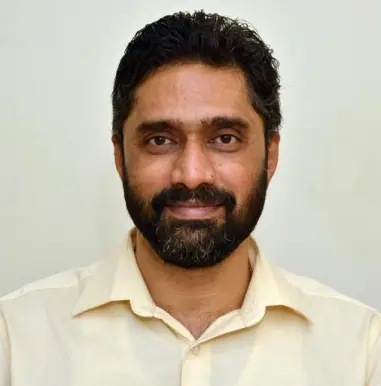
Science is fun, says Baldev Raj of IGCAR
Published in The Hindu on November 17, 2005

“If somebody does not consider science as fun, then science is not for that person,” said Dr. Baldev Raj emphatically. Dr. Raj is the Director of the Kalpakkam based Indira Gandhi Centre for Atomic Research (IGCAR). He made this remark while delivering the Prof. Brahm Prakash Memorial Lecture at Kalpakkam recently to school students.
Speaking to The Hindu he mentioned that many students at all levels — schools and colleges — as he sees it, do not make it to the mark and are not trained to apply what they have learnt to real life situations.
And the reason — inability to get the concepts right. According to him, teachers are partly to be blamed for this. But how can the teacher be held responsible when the system does not encourage it or even provide room for it?
“Even if the system is found lacking, teachers can surely make a difference,” he pointed out. Parents have an equal role to play too.
Catch them young
Inculcating curiosity, observational power and innovative thinking should be started even at a young age. And it is here that the crucial role of teachers and parents comes in to play, he felt.
Many of the major discoveries have come about by mere observation.
“In the field of observation, chance favours the prepared mind,” he noted and cited several instances when chance discoveries have come about from observation — antibiotics by Alexander Fleming or vaccination by Louis Pasteur.
If lack of observation has proved to be one of the banes afflicting science, the ability of students to connect and relate what has been taught with things seen in everyday life is not up to the mark either.
The proof
The Prof. Brahm Prakash Memorial quiz competition conducted the same day by the Kalpakkam chapter of the Indian Institute of Metals for students of XI and XII drove home this point brilliantly.
While it would have been a cakewalk for students to answer direct questions, the quizzing with actual demonstrations of everyday events by the quiz master Dr. Shantanu Chakravorthy of Tata Steel, Jamshedpur, proved a bit difficult for students to answer.
For those students who have resigned to the fact that the 21st Century, unlike the 18th and 19th, offers little chance for any new discovery or invention, Dr. Raj quoted Charles H. Duell to dismiss this wrong notion. “Everything that can be invented has been invented,” Duell had said in 1899! Alas, how wrong Duell was. “In the game of science, the journey is not over,” Dr. Raj remarked.
Not all discoveries have been readily accepted by the society and scientists in particular. Examples are aplenty. If Copernicus was punished, others like the Wright brothers were ridiculed.
Pooh poohed
Many wondered how a machine that is heavier than air could ever fly. The Scientific American magazine dubbed the Wright brothers as “The Lying brothers!”
Or take the case of Alexander Graham Bell. He was prosecuted for fraud when he was found raising money to manufacture telephone equipment. According to the prosecution, carrying voices over wire was impossible and no one would want it done that way! Smithson Tennant discovered that diamond was just another form of carbon in 1766. And scientists ridiculed him for they saw no reason why the hardest and softest material could both be made of carbon.
The courage of conviction is one of the most prized qualities that anyone interested in science should possess.
This becomes particularly important when the person dares to dream differently and challenges the accepted notion. The comments, at times even caustic, from persons of eminence can dissuade or put off people.
How wrong they were
Take for instance the comment by Albert Einstein, one of the greatest scientists of all times, on the possibility of producing nuclear energy.
“There is not the slightest indication that nuclear energy will ever be obtainable. It would mean that the atom would have to be shattered at will,” he said. How wrong he was. Thomas Edison is known more for his discoveries than for his absurd observation. He had come out saying in 1899 that “Fooling around with alternating current is just a waste of time. Nobody will ever use it, ever.” X-rays are a hoax noted Lord Kelvin.
“Science favours those moulded with tenacity to achieve, persistence to solve, courage to interpret and think differently, obsessed with scientific puzzles and who dare to dream,” Dr. Raj underlined.
Ridicule does not have to come at the end though. “But what separates the winner from the rest is conviction and confidence and not others’ approval,” Dr. Raj emphasised. “You can achieve anything if you have the conviction and confidence.”
Brushing away scepticism and ridicule can become a reality only when clarity of mind exists. “The work of Edison and C.V. Raman involved no big equipment,” he noted. “It was just clarity of mind.”
If clarity of mind is important, can intuition be far behind? “Intuition is just being bold. And unless one is confident in one’s intuition one can’t be successful,” he stressed.
If India is now being branded as a knowledge society, it is more an insult than a compliment. That is ignoring the big contributions of our people in the past. It may be recalled that Bhaskarachary had calculated the time taken by the earth to orbit the sun long before others could. Same holds true with Aryabhatta who discovered `zero.’ “We have been world leaders in the past,” Dr. Raj stressed. “If someone tells India will again become one, believe him.”