Black Gold’s Light-Driven Chemistry Reuses Carbon Dioxide Instead of Producing it
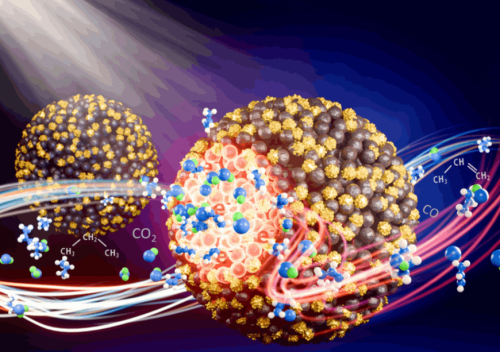
A fully light-driven catalytic system was able to reuse greenhouse gas rather than produce it by converting CO2 to CO while upgrading propane to propene in a single tandem process without relying on external heating or external supply of hydrogen. Instead, hydrogen released when propane is converted into propene was used to transform carbon dioxide
The climate crisis is really a problem of too much carbon in the air. Every year, billions of tonnes of carbon dioxide (CO2) are released into the atmosphere through industrial activity, transportation and energy production. Much of modern-day processes burn fossil resources at extremely high temperatures, consuming vast amounts of energy and driving further emissions. Cutting carbon dioxide emissions is crucial, but equally important is finding ways to reuse the carbon we have already emitted. If we can convert carbon dioxide into something valuable using clean energy, it can become a resource instead of a waste product.
Carbon dioxide is extremely stable, so making it react usually requires very high temperatures and large amounts of hydrogen, a gas that is often made from fossil fuels, producing even more carbon dioxide. Most current methods to recycle carbon dioxide depend on processes that keep producing it, which does not solve the problem. What we need is a new approach that avoids fossil fuels entirely.
Propane to propene: An opportunity with challenges
Carbon dioxide can be converted into carbon monoxide (CO), a key building block for synthetic fuels and chemicals, but hydrogen must be supplied. On the other hand, the petrochemical industry converts propane into propene — a crucial precursor for polypropylene plastics — and this conversion naturally releases hydrogen. Unfortunately, current propane dehydrogenation plants operate at very high temperatures and often suffer from unnecessary side reactions that reduce the selectivity of propene. Solid carbon (coke) also forms and quickly poisons the catalyst, forcing costly shutdowns.
If these two processes — carbon dioxide reduction and propane dehydrogenation — could be integrated efficiently, each would solve the other’s limitations. Hydrogen released from propane could be used immediately to transform carbon dioxide, without ever needing an external supply. But to achieve that integration, the traditional heat-driven paradigm has to be replaced. Our team at the Tata Institute of Fundamental Research (TIFR) Mumbai explored the possibility of overcoming both the challenges: using sunlight alone to power both transformations simultaneously.
A light-powered breakthrough
Our study published recently in the Proceedings of the National Academy of Sciences (PNAS), we demonstrate a fully light-driven catalytic system that converts carbon dioxide to carbon monoxide while upgrading propane to propene in a single tandem process. No external heating. No external hydrogen. Instead, visible light activates both molecules and enables them to react cooperatively.
We created a special ‘black gold’ catalyst. Unlike shiny gold, black gold absorbs almost all sunlight. Tiny gold nanoparticles on a porous support act like tiny light antennae, capturing sunlight and turning it into energetic electrons. These electrons can break chemical bonds directly, allowing reactions to happen without heat.
To make this even more effective, we added three other metals — nickel, gallium, and manganese — that help the reactions happen efficiently and selectively. Propane undergoes selective dehydrogenation to propene, and the energetic electrons promote its prompt desorption from the surface, preventing further reactions that otherwise produce coke in conventional thermal route. At the same time, the hydrogen released from propane activation is directly consumed to reduce carbon dioxide to carbon monoxide, enabling both transformations to operate cooperatively and efficiently within a single light-driven system.
Why it matters
What stands out in this work is not just the combination of two industrially significant reactions but the way in which they proceed. The reaction operates continuously under illumination for more than 500 hours without performance degradation, a major breakthrough considering how rapidly conventional thermal catalysts are deactivated. The selectivity achieved is exceptionally high, meaning energy and material inputs are used efficiently rather than wasted on side reactions.
Most importantly, the entire process occurs without burning any fuel. Light replaces heat as the primary energy source, fundamentally decoupling chemical manufacturing from direct fossil-fuel consumption.
This offers a powerful pathway to reduce emissions from two sectors simultaneously: carbon dioxide management and plastic-precursor production.
Scaling up
Both products of this tandem process — carbon monoxide and propene — sit at the foundation of global manufacturing industries. By producing them using sunlight the technology paves the way toward a circular carbon economy in which greenhouse gases are continuously reused rather than released.
Scaling this innovation from the laboratory to industrial settings will require engineering advances in light delivery, reactor design and catalyst shaping. Yet, the core principle has been established: light can drive demanding, industrially relevant chemical transformations that were once considered possible only at extreme temperatures.
A future built on clean chemistry
Our results demonstrate how nanoscience can address one of humanity’s most urgent challenges. Rather than viewing carbon dioxide as an unavoidable burden, we show that it can be incorporated into a sustainable chemical cycle that replaces heat with light and transforms waste into value. As technologies like plasmonic black gold continue to advance, they point toward a future in which factories are powered by sunlight, carbon is continuously recycled, and essential materials are produced without compromising the climate.