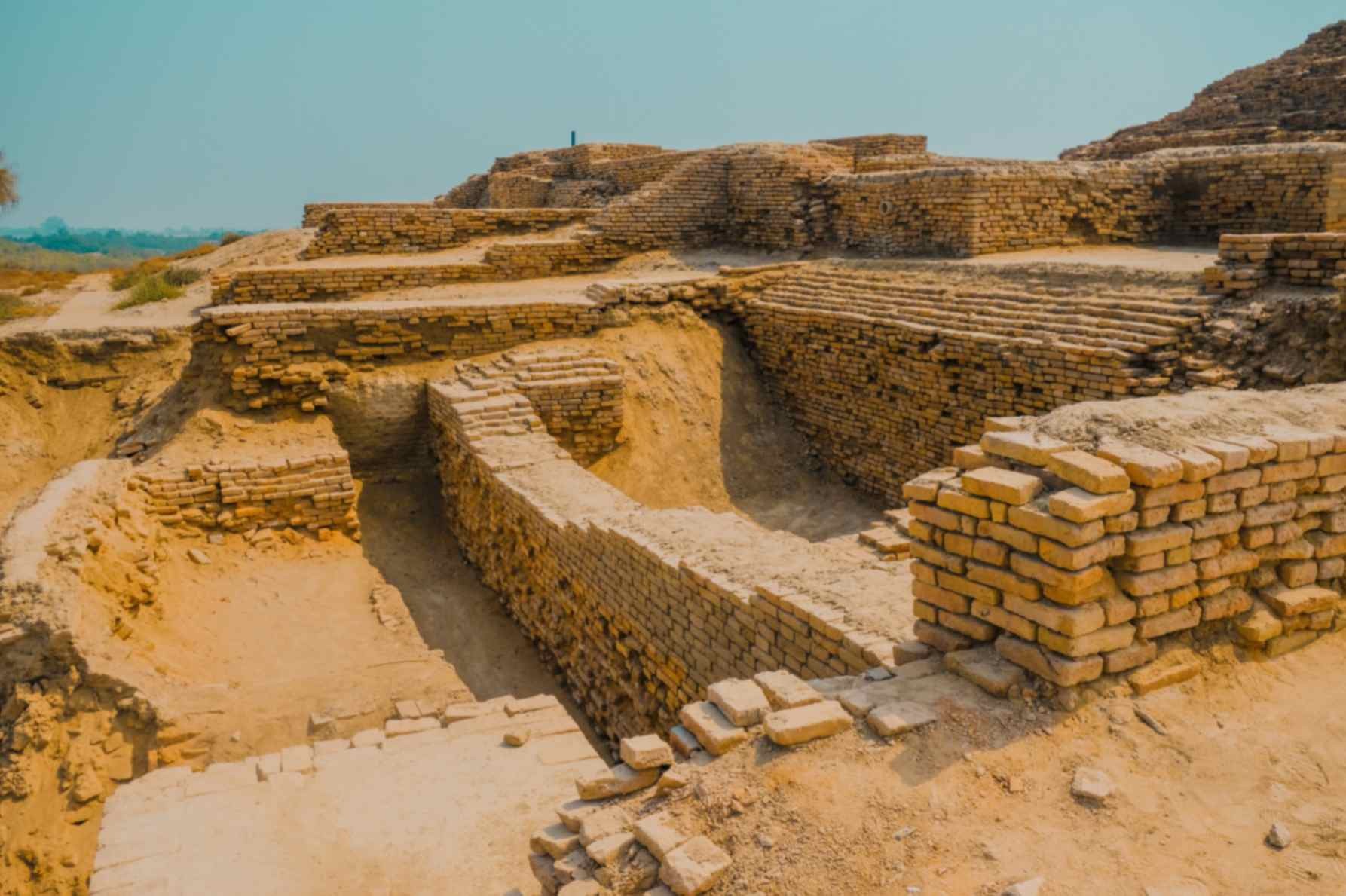
Four major, extended droughts likely caused the Indus Valley Civilization’s collapse
A study by IIT Gandhinagar has linked Indus Valley Civilization’s collapse to four severe droughts lasting for 88-164 years between 4,400 and 3,400 years ago with up to 20% reduction in rainfall, reduced river discharge of over 12%, together with 0.5 degree C warming
The decline and eventual fall of the Indus Valley Civilization beginning about 3,900 years ago was due to four severe droughts that came in relatively quick succession, and with each drought lasting for extended periods — over 85 years — a study published recently in the journal Communications Earth & Environment says.
“Our study reexamined the role of drought in collapsing the Indus Valley Civilisation and established that the collapse occurred due to several droughts rather than a single drought event. We also highlighted the amazing capabilities of the civilisation to adapt and survive for thousands of years through migration,” says Dr. Vimal Mishra from the Department of Civil Engineering, IIT Gandhinagar who led the study.
The Indus Valley Civilisation existed between 5,000 and 3,500 years ago around the Indus River and its tributaries in modern-day Pakistan and northwest India. It was characterised by advanced cities and sophisticated water management. The reasons for the decline of such a civilisation were not fully understood.
The team used three transit climate simulations to extract the rainfall and temperature data and modelled them to understand the streamflow and hydrological variables. The palaeoclimate and hydrological conditions were then validated using already available geochemistry data of stalactites and stalagmites from five caves and the water level records of five lakes in northwest India. Data from three caves showed 39-50% correlation between geochemistry of stalactites and stalagmites and rainfall data. “The other two caves captured the trend but not the exact timing as the caves were situated far away from the region,” says Hiren Solanki from IIT Gandhinagar and the first author of the paper.
Extended droughts
There were four severe droughts, with the first drought lasting for 88 years (from 4,445-4,358 years ago), followed by the second drought lasting for 102 years (from 4,122-4,021 years ago), the third lasting for 164 years (from 3,826-3,663 years ago) and the last drought lasting for 114 years (from 3,531-3,418 years ago).
The third drought was the most severe of the four as it not only lasted for a longer period (164 years), the mean intensity was also higher and the mean area under drought was as high as 91%. The annual reduction in rainfall was 12.38%. In comparison, the fourth drought had a slightly higher reduction in rainfall of 12.70%, yet was less severe than the third drought. “Though the reduction in rainfall during the last drought was slightly higher than the third event, the duration of the drought was short (114 years) and the mean intensity was slightly less than the third drought. So the severity of the last drought was less than the third drought,” explains Solanki.
Reduction in rainfall
“The winter rainfall was above average while only the summer rainfall reduced especially during the first drought. However, winter rainfall also reduced along with summer rainfall during the third and fourth drought. But compared with the third drought, winter rainfall improved marginally during the fourth drought,” says Solanki.
The average reduction in rainfall across the Indus Valley Civilization region was modest — about 10% — across the entire region 4,500-3,900 years ago. In contrast, between 3,900 and 3,000 years ago, the average reduction in rainfall across the region was 10-15%, with 20% reduction seen in the central region and 15-20% seen in the peripheral areas. The simulations indicate declines of about 13-15% in annual, summer, and winter rainfall with a significant decreasing trend of about 0.7 % per century.
Riverflow was greatly impacted during the third and fourth drought, with some of the sites studied experiencing reduced discharge of more than 12%. The lower and upper Indus regions showed a maximum reduction of over 9% in riverflow during the last drought, while two sites experienced about 12% reduction in riverflow, suggesting water scarcity in the Indus River 3,900-3,000 years ago.
0.5 degree C warming
Concomitant with reduction in rainfall, there was about 0.5 degree C rise in the annual mean temperature between 4,400 and 3,400 years, with a significant warming trend of 0.024 degree C per century. The increase in annual mean temperature between 4,400 and 3,400 years might have might have increased the atmospheric water demand and thus evapotranspiration, making the droughts more severe.
“Initially, drought was intense in the peripheral areas. This led to people shifting to the central areas,” he says. The drying over the regions from 4,000 to 3,000 years ago was “more dominant” and mainly in the central areas especially during the third and fourth drought. “Based on our climate simulations and paleoclimate evidence, we suggest that drought initiation in the Indus Valley Civilization region began around 4,440 years ago, coinciding with shifts in settlement patterns and cultural reorganisation,” the authors write. “Because the central areas were severely affected, the settlements shifted to the Himalayan and Saurashtra regions,” says Solanki. Unlike the Indus Valley Civilization region, Saurashtra had better rainfall and the Himalayan region experienced increased temperature leading to increased melting of ice and hence increased water availability.
Featured image credit: Jawwad Ali