Karakoram region: Changmolung Glacier’s Unusual Melting Linked to Geothermal Spring
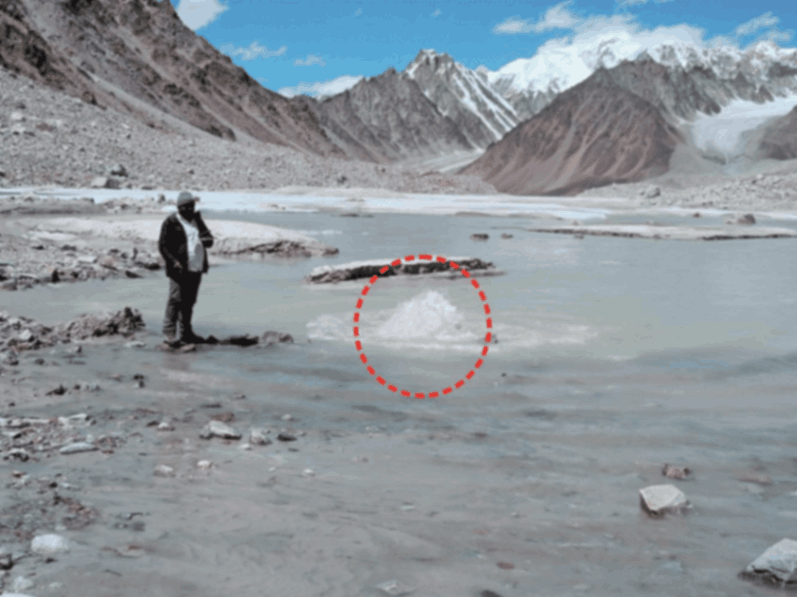
A geothermal spring located at an elevation of about 4,980 metres above mean sea level (msl) has a slightly higher temperature of 8-10 degrees C. Higher geothermal heat flow significantly increases both basal temperatures and water content, thus accelerating ice melting
A geothermal spring (also known as hot spring) located in the Changmolung Glacier’s terminus (the lowest end of a glacier) in the upper Nubra Valley, Karakoram region appears to have played a critical role in the anomalous melting of glaciers in the lowest elevation, a recent study has found. The geothermal spring is located at an elevation of about 4,980 metres above mean sea level (msl) and has a slightly higher temperature of 8-10 degrees C. Higher geothermal heat flow significantly increases both basal temperatures and water content, thus accelerating ice melting. The results of the study were published recently in the journal Science of the Total Environment.
Prior to this study, there have not been any field-based observations of geothermal activity accelerating glacier melting in the Karakoram region though previous studies had indicated geothermal activities in various parts of the region. Earlier studies focused primarily on climatic factors to explain glacier dynamics.
In contrast to widespread global glacier shrinkage, the Karakoram region has witnessed a balanced or more glacier ice gains than losses since at least 1970s, a phenomenon termed the “Karakoram Anomaly” by Professor Kenneth Hewitt of Wilfrid Laurier University, Canada, in 2005. However, the Changmolung Glacier in the Karakoram region stands out as a sore thumb with unusual glacier retreat. While the Changmolung Glacier recorded an overall mass gain of 0.51 meters of water equivalent per year (m w.e. a⁻¹) between 2000 and 2016, the mass gain at the glacier terminus near the geothermal spring was minimal (0.15 m w.e. a⁻¹). From an overall mass gain seen till 2016, the Changmolung Glacier experienced considerable mass loss at lower elevations between 2016 and 2023, with the mass loss becoming substantial near the geothermal spring.
Surprising find
The presence of the geothermal spring was not known till 2022. In 2022, Dr. Rakesh Bhambri along with Dr. Sameer Tiwari and Dr. Jairam Singh Yadav from the Wadia Institute of Himalayan Geology discovered the geothermal spring during a field expedition to the Changmolung Glacier. “During a field work in 2022, we trekked 3 km to reach the terminus of the glacier. It was then we saw the thermal spring by chance. We were surprised to see it,” Dr. Bhambri recalls. “Once we completed the field work, we analysed satellite data and digital elevation models.” The satellite data revealed that in 1969, the geothermal spring was located about 340 metres upstream from the Changmolung Glacier terminus and was concealed beneath thick ice. It became exposed in 2004-2005.
Between 1969 and 2022, the Changmolung Glacier receded by 478 metres at an average rate of 9 metres per annum. At 9.2 metres per annum, the mean frontal retreat of the glacier was more than the average rate between 1969 and 2009, which slightly decreased from 2009 to 2022 (8.4 metres per annum). The geothermal spring located near the glacier terminus increased the melting of the glacier accelerating the frontal retreat.
A stake network
To understand the thinning of the Changmolung Glacier, in August 2022, the researchers installed bamboo stakes at four points at elevations between 4,980 and 5,200 metres MSL in the lower ablation zone near the terminus. “The locations where the stakes were installed allowed us to determine glacier thinning, including the areas influenced by the hot spring,” says Dr Bhambri. “Two stakes were placed in clean ice near the left and right moraines, and the other two were positioned in the debris-covered central region of the glacier.”
Based on the stake network installed in 2022, the researchers found the melting was maximum (about 3.90 metres per annum) at about 5,140 metres MSL in the central region of the glacier along the geothermal spring line between 2022 and 2023. In contrast, melting near the left and right lateral moraines was significantly less (1.92 metres per annum) than the central part.
In 2022 and 2023, the geothermal spring exhibited higher temperatures (8-10 degree C) compared with subzero temperatures of adjacent glacier meltwater. This significant temperature difference in the glacier meltwater suggests increased melting of glacial ice near the hot spring due to localised heat flux from the geothermal spring. “Data from the stakes revealed accelerated ice ablation, supporting the hypothesis of localised ice mass loss caused by geothermal heating,” he says.
The rapid glacier melting along the geothermal spring exposed debris of varying thickness, while both the left and right sides of the glacier remained unaffected and clean. The uneven melting caused significant changes in glacier morphology in the form of undulating surface in the lower ablation zone. The glacier mass changes at Changmolung are caused by climatic and geothermal activity. The enhanced thinning near the geothermal spring indicates a localised anomaly rather than a region-wide decline of the Karakoram Anomaly.
Chemical signature
The geothermal spring water has a distinct chemical signature — high calcium concentration (73%) and lower sulphate concentration (54%) — compared with glacier meltwater, ice, and fresh snow. Also, geothermal spring water is alkaline (pH 8.3) compared with near-neutral pH of 6.8 for glacier meltwater, highlighting the substantial chemical differences between the two water sources. There was higher mineral concentration in geothermal spring water than in glacier meltwater. Also, dissolved oxygen content was higher in the spring water (8.1 mg/L) than in glacier meltwater (5 mg/L). “The sulphur deposits indicate geothermal activity, increasing temperatures, and intensifying glacier loss through enhanced surface and basal melting,” the authors write. Dr. Kalachand Sain, Dr. Arindam Chowdhury, Ms. Sarmistha Halder from Wadia Institute of Himalayan Geology are also authors of the papers.
“Our study highlights the crucial role of geothermal activity in shaping glacial dynamics and emphasises the need to integrate geothermal assessments into future glaciological research to better understand the diverse glacier responses in the Karakoram region,” says Dr. Bhambri.