IIT Dhanbad researcher with 34 retractions gets promoted as Associate Professor
In August 2018, former IIT Dhanbad Director had said that scientific misconduct by Prashant K Sharma and Rashmi Madhuri appears serious and may attract major penalty. In April 2021, Prashant Sharma was promoted as Associate Professor
- Babies indulge in plagiarism
- Kids publish in predatory journals
- Adults manipulate and/or duplicate images, use LLMs without disclosure
- Legends continue reviewing papers when their names are added during the reviewing process
- Gods get promoted despite having nearly three dozen retracted papers
Prashant K Sharma from the Department of Physics, Indian Institute of Technology Dhanbad has collected 34 retractions till date. In March 2018, a fact-finding committee of four members began investigating misconduct after over two dozen papers of Dr. Rashmi Madhuri and Dr. Sharma were retracted. Dr. Madhuri is Assistant Professor in the Department of Chemistry and Chemical Biology at IIT Dhanbad.
In August 2018, Dr. Rajiv Shekhar, Professor and then Director of IIT Dhanbad at that time, told me that the investigation was completed. He said scientific misconduct by the two researchers appears serious and may attract major penalty.
He also said: “…Needless to say that we take such issues very seriously… The board will take a decision depending on the extent of guilt. The investigation will be completed shortly.”
In June 2019: Dr. Shekhar said: “The investigation is yet to be completed”.
Fastforward to 2025
The content of committee report and the outcome of the Board’s decision are not known. But what one can guess is that Dr. Sharma surely did not face any “major penalty”. Instead, he was rewarded — he was promoted as Associate Professor in April 2021!
Belatedly responding to emails, Dr. Sarat Kumar Das, Professor and Dean (Faculty) at IIT Dhanbad sent a brief response on July 23, 2025. He said: “…Necessary departmental actions have been taken in the matter of Prof. Prashant Kumar Sharma and Prof. Rashmi Madhuri. However, the details of the actions taken in this regard cannot be shared… for the reason that the details are of confidential nature. Moreover, the matter is still under consideration with the Visitor of this Institute.”
Dr. Madhuri is the corresponding author in 29 retracted papers and in every paper where she is an author, while Dr. Sharma is a corresponding or co-corresponding author in four papers.
In early December 2017, Dr. Madhuri had accused scientists posting on Pubpeer as trying to defame her. “They are just posting comments without reading our papers,” she said then. In another email sent in December 2017, she said: “We would like to mention that all our articles are published in very reputed journals, after a very rigorous and transparent review process adopted by the concerned journals. The referees and editorial board have approved our work and published them.”
According to the publication details of Dr. Prashant Sharma, last updated in April 2025, 115 papers have been published in journals. Of them, 56 papers are in Q1 journals, 16 papers are in Q2 journals, nine papers are in Q3 journals, and 14 papers are in Q4 journals. While the titles of book chapters are listed, there is no similar list for published papers.
List of retracted papers
- Design and surface modification of potential luminomagnetic nanocarriers for biomedical applications
- Red luminescent manganese-doped zinc sulphide nanocrystals and their antibacterial study
- Bimetallic magnetic nanoparticle as a new platform for fabrication of pyridoxine and pyridoxal-5′-phosphate imprinted polymer modified high throughput electrochemical sensor
- Green luminescent ZnO:Cu2 + nanoparticles for their applications in white-light generation from UV LEDs
- Rare Earth- and Iridium-Decorated Silica Nanoparticle as a Single Catalyst for Carbon Dioxide Reduction and Water Oxidation: Buy One Get One Strategy
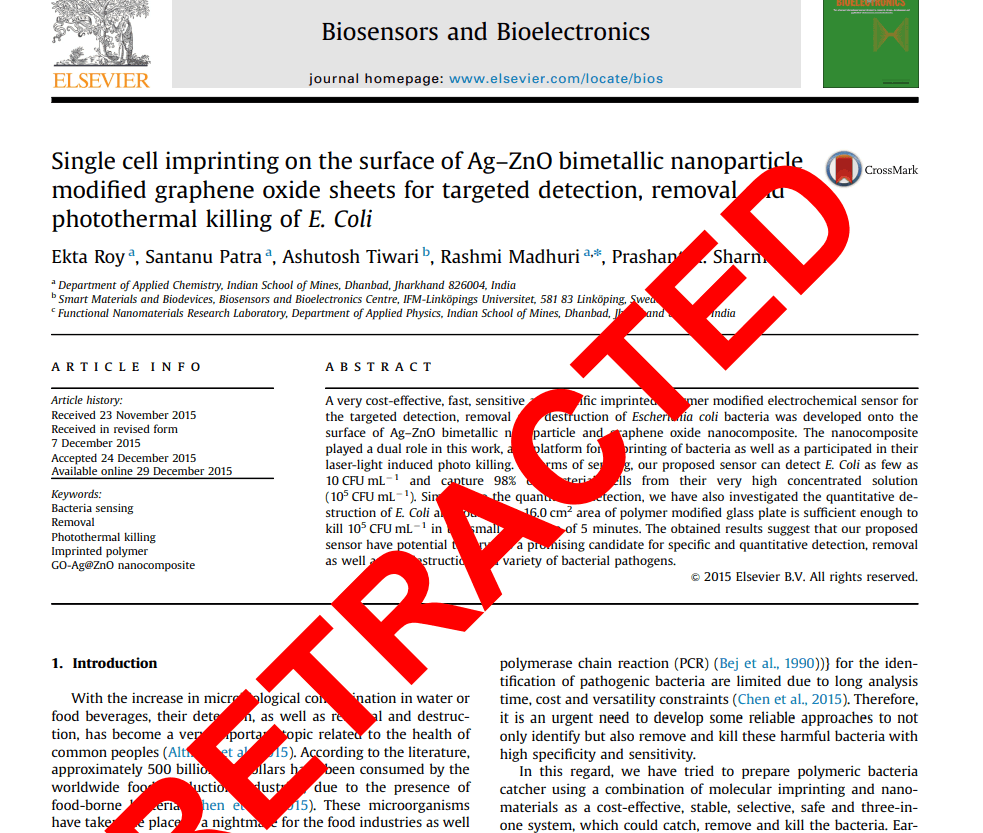
- Single cell imprinting on the surface of Ag-ZnO bimetallic nanoparticle modified graphene oxide sheets for targeted detection, removal and photothermal killing of E. Coli
- Designing of transition metal dichalcogenides based different shaped trifunctional electrocatalyst through “adjourn-reaction” scheme”
- Single cell imprinting on the surface of Ag–ZnO bimetallic nanoparticle modified graphene oxide sheets for targeted detection, removal and photothermal killing of E. Coli Multifunctional magnetic reduced graphene oxide dendrites: Synthesis, characterization and their applications
- Multifunctional magnetic reduced graphene oxide dendrites: Synthesis, characterization and their applications
- Imprinted ZnO nanostructure-based electrochemical sensing of calcitonin: A clinical marker for medullary thyroid carcinoma
- Graphene quantum dots decorated CdS doped graphene oxide sheets in dual action mode: As initiator and platform for designing of nimesulide imprinted polymer
- Bimetallic magnetic nanoparticle as a new platform for fabrication of pyridoxine and pyridoxal-5′-phosphate imprinted polymer modified high throughput electrochemical sensor
- An imprinted Ag@CdS core shell nanoparticle based optical-electrochemical dual probe for trace level recognition of ferritin
- A fluorescent molecularly-imprinted polymer gate with temperature and pH as inputs for detection of alpha-fetoprotein
- Dual-Responsive Polymer Coated Superparamagnetic Nanoparticle for Targeted Drug Delivery and Hyperthermia Treatment
- Multifunctional fluorescent chalcogenide hybrid nanodots (MoSe2:CdS and WSe2:CdS) as electro catalyst (for oxygen reduction/oxygen evolution reactions) and sensing probe for lead
- Anisotropic (spherical/hexagon/cube) silver nanoparticle embedded magnetic carbon nanosphere as platform for designing of tramadol imprinted polymer
- Removal and Recycling of Precious Rare Earth Element from Wastewater Samples Using Imprinted Magnetic Ordered Mesoporous Carbon
- Equipment-Free, Single-Step, Rapid, “On-Site” Kit for Visual Detection of Lead Ions in Soil, Water, Bacteria, Live Cells, and Solid Fruits Using Fluorescent Cube-Shaped Nitrogen-Doped Carbon Dots
- Economic and Ecofriendly Synthesis of Biocompatible Heteroatom Doped Carbon Nanodots for Graphene Oxide Assay and Live Cell Imaging
- Carbon dot/TAT peptide co-conjugated bubble nanoliposome for multicolor cell imaging, nuclear-targeted delivery, and chemo/photothermal synergistic therapy
- Size-specific imprinted polymer embedded carbon nanodots modified magnetic nanoparticle for specific recognition of titanium nanoparticle: The round versus round
- Triple signalling mode carbon dots-based biodegradable molecularly imprinted polymer as a multi-tasking visual sensor for rapid and “on-site” monitoring of silver ions
- The next generation cell-penetrating peptide and carbon dot conjugated nano-liposome for transdermal delivery of curcumin
- Doping, strain, defects and magneto-optical properties of Zn1-xMnxO nanocrystals
- Creation of ultrasound and temperature-triggered bubble liposomes from economical precursors to enhance the therapeutic efficacy of curcumin in cancer cells
- A battle between spherical and cube-shaped Ag/AgCl nanoparticle modified imprinted polymer to achieve femtogram detection of alpha-feto protein
- Amino acid derived highly luminescent, heteroatom-doped carbon dots for label-free detection of Cd2+/Fe3+, cell imaging and enhanced antibacterial activity
- Shape-specific silver nanoparticles prepared by microwave-assisted green synthesis using pomegranate juice for bacterial inactivation and removal
- Doping, strain, defects and magneto-optical properties of monodispersed Zn1-xMnxO nanocrystals
- Anisotropic Gold Nanoparticle Decorated Magnetopolymersome: An Advanced Nanocarrier for Targeted Photothermal Therapy and Dual-Mode Responsive T1 MRI Imaging
- Cow Dung Derived PdNPs@WO3 Porous Carbon Nanodiscs as Trifunctional Catalysts for Design of Zinc–Air Batteries and Overall Water Splitting
- Designing of carbon based fluorescent nanosea-urchin via green-synthesis approach for live cell detection of zinc oxide nanoparticle
- Shape-specific silver nanoparticles prepared by microwave-assisted green synthesis using pomegranate juice for bacterial inactivation and removal