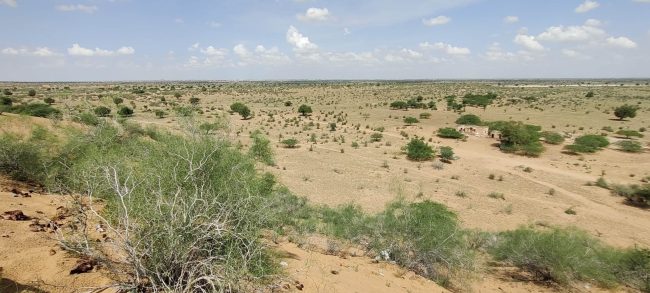
Brown is Gold: Why India Must Stop Calling Its Deserts as Wastelands
Let’s be clear: not all tree-planting is good. In Rajasthan’s Bikaner district, for instance, climate schemes involving tree planting have led to plummeting groundwater levels, soil acidification, and the loss of native grasses vital to both wildlife and pastoralists
Scroll across a satellite map of India and you will see a stunning palette of colours unfurl across the subcontinent. Fringed by seas as deep and blue as lapis, the land glows green in the rain-rich Northeast and along the lush Western Ghats. To the north, the Himalayas rise like jagged pearl spines, glinting over some of the highest and coldest parts of the planet.
But at the heart of the subcontinent, your gaze will inevitably fall on the browns: the ochres, sands and sunbaked earth tones that stretch across peninsular India. The sandy brown Thar desert that forms our western border or ancient volcanic red laterite soils of The Deccan plateau do not receive the bounty of the summer monsoon rains. These drylands, however, are no less dramatic than forests or mountains, yet they rarely inspire the same awe. Instead, they are dismissed as empty, barren, and in need of “greening”.
The violence of a single word
At the heart of this bias lies a single, outdated label: wasteland. Even today, grasslands, scrublands, deserts and savannas, ecosystems that make up a massive 10-15% of the country, are still officially marked as such. Not only is this a vestige from colonial times that viewed all unproductive land as wasteful, till very recently the government also promoted this narrative by releasing a “Wasteland Atlas of India”. In short, if it does not grow crops or host dense forests, we assume it has no value.

But words shape policy, and this one has led to deep ecological damage. Once tagged as “wasted,” the land becomes a blank slate for whatever development dream comes next. In the process of finding more useful purposes such as industrial parks, tree plantations and infrastructure, we erase ecosystems that are ancient, complex, and uniquely adapted to extremes. Unlike degraded lands, such Open Natural Ecosystems (ONEs) are naturally sparsely vegetated, familiarised to seasonality, drought, fire, and grazing.
Open Natural Ecosystems are subtle, but rich in a manner that the popular imagination has yet to reconcile with. Desert landscapes sport highly-adapted species, such as seeds that wait years for rain, animals that sleep through heat, and even people who have learned to live with scarcity rather than against it. When we destroy such areas, we further endanger species like the Great Indian Bustard, caracal, and Indian wolf that have evolved to survive and thrive off these lands.
What gets lost in the rush to plant trees
Let’s be clear: not all tree-planting is good. In many cases, afforestation projects flatten grasslands and scrub, replacing native biodiversity with monoculture plantations. These “green” efforts may look great from a drone, but they erase identity and unravel centuries of balance.
They also stress already-scarce groundwater. Non-native trees often drink more than the land can offer, outcompeting local flora and altering soil chemistry. In Rajasthan’s Bikaner district, for instance, climate schemes involving tree planting have led to plummeting groundwater levels, soil acidification, and the loss of native grasses vital to both wildlife and pastoralists.

And it is not just the animals that are at risk. These interventions often displace entire communities, especially the pastoralists, such as the Rabari, Dhangar and Kuruba, who rely on these landscapes for seasonal grazing. Their movements, practices, and deep-rooted knowledge of land cycles are all jeopardised when grasslands are fenced off or declared forests overnight. In burying these lands under trees or policies that fail to recognise their true identity, we dismantle centuries of resilient, place-based knowledge and livelihoods.
Why doesn’t India see its deserts?
At its core, this is a crisis of ecological imagination. And yet, it would be wrong to assume that all drylands are treated this way across the world. Far from being dismissed, ecosystems like the African savannas, Central Asian steppes, and South American pampas are recognised as vital landscapes. They are protected, studied, celebrated, and prominently featured in global desert and dryland atlases.
By contrast, India’s own brownlands remain largely invisible. They are absent not only from international datasets but also from domestic maps, policies, and public discourse. This neglect is particularly ironic given our history. Some of the world’s first great civilisations, such as the Mesopotamia, Egypt, and the Indus Valley, emerged in desert environments. These spaces challenged humanity to innovate, cooperate, and endure.
Even today, these regions deserve serious attention. India’s drylands store vast amounts of carbon beneath the soil, a contribution often overlooked simply because they lack the visual appeal of towering forests. Open Natural Ecosystems are among the most important carbon sinks in the country, yet they are frequently sidelined in national climate action plans and biodiversity strategies. Without a visible canopy, it seems, their value is too easily dismissed.

Time for a new story
As climate extremes become our daily reality, deserts offer a kind of wisdom we desperately need: how to thrive with less. How to slow down. How to make water stretch. Restoration in drylands does not mean forcing them to become forests. It means improving soil health, reviving native grasses, harvesting water smartly, and listening to communities who have always known how to live with the land.
To truly support these ecosystems, India needs to move beyond symbolism. That means integrating Open Natural Ecosystems into climate and biodiversity policy, recognising soil carbon as a critical climate tool, and empowering local communities as stewards, not trespassers, of the land.
Every year, June 17 is observed as the ‘World Day to Combat Desertification and Drought’. But the name itself reflects the flawed metaphor that deserts are the endpoint of degradation. So, in the interest of calling a spade a spade, it is time we reframe it. So let us take our spades and shovels, and lay the old “Desert Day” to rest. The future won it be built by forcing deserts to become something they are not, but by finally learning to live wisely, and respectfully, in brown.
(Header image photo credit: Abi T. Vanak)